
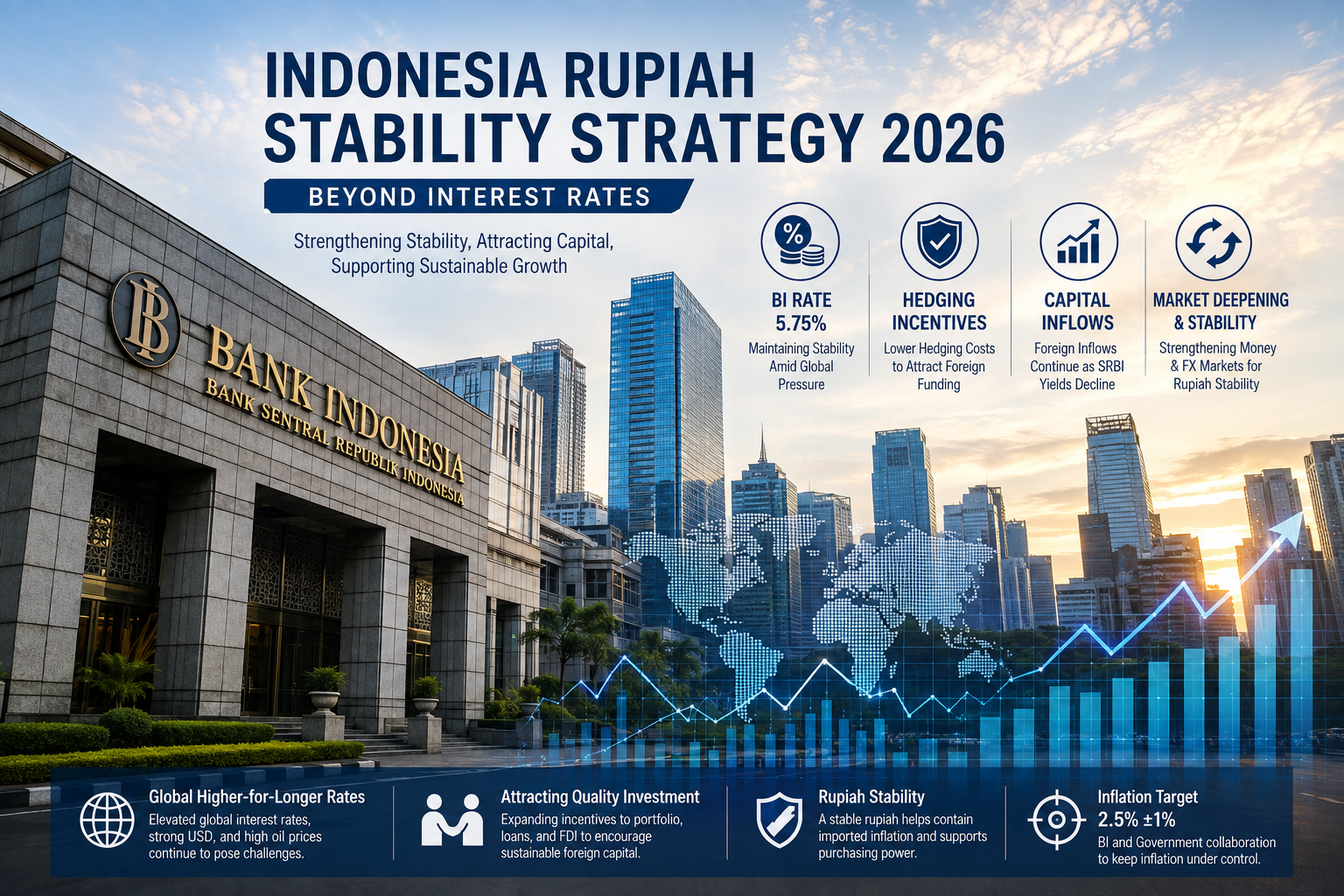



Indonesia Rupiah Stability Strategy 2026 is increasingly relying on more than the policy rate alone. Bank Indonesia has kept the BI Rate at 5.75% as global financial pressure remains elevated, but the central bank is also expanding other instruments to support the rupiah, attract foreign capital, and reduce vulnerability to external shocks.
The broader approach reflects a difficult policy environment. Global interest rates remain high, the US dollar stays firm, oil prices are elevated, and investor appetite for emerging-market assets remains cautious. In this setting, BI is seeking a balance between preserving currency stability and avoiding unnecessary pressure on domestic growth.
Indonesia Rupiah Stability Strategy 2026 Faces Higher-for-Longer Rates
A major challenge for Indonesia Rupiah Stability Strategy 2026 comes from the global higher-for-longer interest-rate environment.
The Federal Reserve is expected to maintain relatively high interest rates as US inflation remains elevated. At the same time, high oil prices and continued financial-market uncertainty have kept bond yields and global funding costs at high levels.
These conditions reduce investor preference for portfolio assets in emerging markets and help keep the US dollar strong against both developed- and emerging-market currencies. For Indonesia, this means rupiah stability cannot depend solely on domestic interest-rate decisions.
BI Expands Its Toolkit Beyond the Policy Rate
The key feature of Indonesia Rupiah Stability Strategy 2026 is the wider use of monetary instruments outside the BI Rate.
Bank Indonesia has maintained the policy rate at 5.75% for two consecutive months, while simultaneously expanding incentives and financial-market instruments designed to support capital inflows and deepen the domestic money and foreign-exchange markets.
This strategy allows BI to defend currency stability without relying exclusively on higher interest rates, which could otherwise place additional pressure on domestic demand and economic activity.
Lower Hedging Costs Could Support Foreign Capital
One of the most important elements of Indonesia Rupiah Stability Strategy 2026 is the expansion of hedging incentives for foreign funding.
BI has widened the scope of foreign funding transactions eligible for a 12.5% reduction in the premium for hedging swap transactions. Previously, the incentive mainly covered portfolio inflows. It now extends to foreign loans received by banks and foreign direct investment.
The expanded framework is scheduled to take effect in the second week of September 2026 for foreign loans and FDI entering Indonesia from July 1, 2026 onward.
By lowering hedging costs, BI aims to preserve an attractive spread for foreign investors while making it easier to manage currency risk.
Foreign Inflows Continue as SRBI Yields Decline
Another notable part of Indonesia Rupiah Stability Strategy 2026 is BI’s effort to maintain foreign inflows without pushing SRBI yields higher.
SRBI yields declined over the previous two weeks, yet foreign portfolio inflows continued. Net inflows in the capital and financial account reached US$1.8 billion as of August 14, supported by government global bond issuance as well as inflows into SBN and SRBI.
This suggests that foreign capital attraction does not need to depend entirely on increasingly expensive yields, especially if policy incentives and market infrastructure improve.
Rupiah Stability Also Helps Contain Imported Inflation
The importance of Indonesia Rupiah Stability Strategy 2026 extends beyond the foreign-exchange market.
A more stable rupiah can help limit imported inflation, particularly when global commodity and energy prices remain high. BI continues to target inflation at 2.5% ±1% and is working with the government through TPIP and TPID to manage food inflation and potential supply disruptions, including weather-related risks such as El Niño.
This means rupiah stability also supports household purchasing power by reducing the risk that external price pressures are transmitted too strongly into the domestic economy.
Key Takeaways
Indonesia Rupiah Stability Strategy 2026 is becoming broader and more flexible. Bank Indonesia is keeping the BI Rate at 5.75%, but it is also using hedging incentives, market-deepening measures, SRBI management, and foreign-capital incentives to strengthen currency stability.
The strategy reflects an effort to protect the rupiah while supporting growth, maintaining investor interest, and containing imported inflation in a challenging global environment.
For professional foreign currency services, Cash X Change operates as an Authorized Money Changer, providing competitive and transparent exchange rates. For international remittances, Ditransferin facilitates money transfers and cash withdrawals through Western Union, helping individuals and businesses manage cross-border transactions securely.
Source: Investor Daily, August 20, 2026