




Indonesia Inflation Stability 2026 is showing encouraging signs as the rupiah strengthens and domestic inflation eases. However, the current improvement remains conditional, with Bank Indonesia continuing to monitor global uncertainty, food-supply risks, production costs, and the potential impact of El Niño on prices.
Bank Indonesia maintained the BI Rate at 5.75% in August, alongside the deposit facility rate at 4.75% and lending facility rate at 6.50%. The decision reflects an effort to preserve rupiah stability, keep inflation within the 2.5% ±1% target range, and support sustainable economic growth.
Indonesia Inflation Stability 2026 Shows Improvement
Recent data support a more stable Indonesia Inflation Stability 2026 outlook.
The rupiah reached Rp17,855 per US dollar on August 18, strengthening 0.78% from its position at the end of July. Bank Indonesia expects the currency to remain relatively stable as policy measures to support the exchange rate continue.
Inflation has also moderated. Indonesia’s annual inflation rate declined to 2.88% in July 2026 from 3.34% in June, giving policymakers more room to maintain the current interest-rate stance.
Yet these improvements do not mean inflation risks have disappeared.
A Stronger Rupiah Provides an Important Buffer
Currency stability remains an important component of Indonesia Inflation Stability 2026.
A firmer rupiah can help reduce the transmission of external price pressures into the domestic economy, particularly when imported goods or production inputs are priced in foreign currencies.
This is one reason BI continues to place exchange-rate stability at the center of its policy approach. If global financial conditions worsen and pressure on the rupiah returns, the central bank may need to reconsider its current stance.
El Niño Emerges as a New Inflation Risk
A less obvious challenge to Indonesia Inflation Stability 2026 comes from climate conditions.
Bank Indonesia has warned that El Niño could strengthen through October 2026, particularly in eastern Indonesia. The concern is that adverse weather conditions could disrupt agricultural production, increase production costs, or interfere with food supply.
Rice, chili peppers, and shallots are among the commodities receiving particular attention because changes in supply and distribution can influence food-price inflation.
This shows that monetary stability does not depend exclusively on financial markets. Weather, food production, and distribution networks can eventually influence inflation and household purchasing power.
Food Supply and Distribution Become Critical
Maintaining Indonesia Inflation Stability 2026 will therefore require coordination beyond interest-rate policy.
BI plans to strengthen inflation control through efforts to maintain food availability and smooth distribution. These measures are important because supply disruptions can create price pressure even when broader demand conditions remain manageable.
For consumers, stable food prices are particularly important because increases in essential goods can quickly affect household budgets and purchasing power.
Global Pressure Could Change the Outlook
External conditions remain another major variable for Indonesia Inflation Stability 2026.
Bank Indonesia continues to monitor uncertainty linked to the conflict in the Middle East and other global developments. A deterioration in external conditions could place renewed pressure on the rupiah and increase imported inflation risks.
This means the current decision to keep rates unchanged should not be interpreted as a guarantee that monetary policy will remain static through the end of the year.
Could BI Rate Rise to 6.25%?
Economists remain divided about the next phase of Indonesia Inflation Stability 2026.
Permata Bank Chief Economist Josua Pardede expects BI to maintain the 5.75% policy rate through the end of 2026. Bank Danamon Lead Economist Irman Faiz, however, sees a possibility that the BI Rate could rise to 6.25% if external pressure on the rupiah and inflation intensifies.
The difference between these forecasts highlights how dependent the policy outlook remains on incoming data.
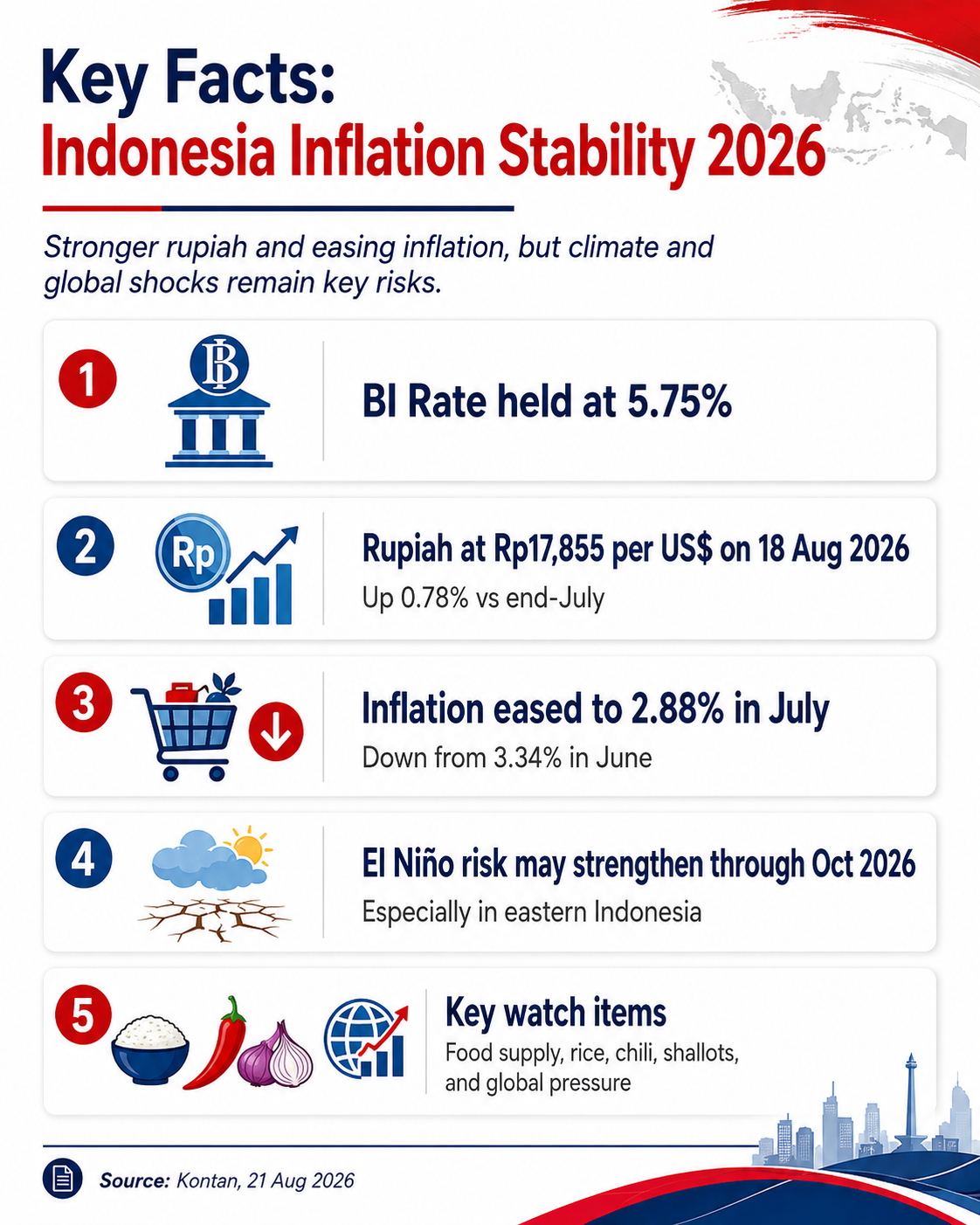
Key Takeaways
Indonesia Inflation Stability 2026 is currently supported by a stronger rupiah and lower inflation, but the outlook remains vulnerable to climate and global risks.
El Niño, food-supply disruptions, production costs, exchange-rate pressure, and external uncertainty could all influence inflation and ultimately determine whether Bank Indonesia needs to tighten policy again.
For professional foreign-currency exchange, Cash X Change operates as an Authorized Money Changer, providing competitive and transparent exchange rates. For international remittances, Ditransferin facilitates money transfers and cash withdrawals through Western Union, helping customers manage cross-border financial needs securely.
Source: Kontan, August 21, 2026