




Indonesia Productive Growth 2026 is being supported by a combination of resilient domestic fundamentals, strong investment, and accelerating credit growth. While broad money growth has moderated, lending activity continues to strengthen, creating an important financial foundation for Indonesia’s industrial transformation and expansion of productive capacity.
The government is simultaneously accelerating downstreaming, investment, state-owned enterprise reform, and strategic projects aimed at creating new sources of economic growth. The challenge is ensuring that financial liquidity is effectively transmitted into productive sectors that can generate higher value added, employment, and broader economic benefits.
Indonesia Productive Growth 2026 Builds on Strong Fundamentals
The outlook for Indonesia Productive Growth 2026 is supported by relatively solid domestic conditions.
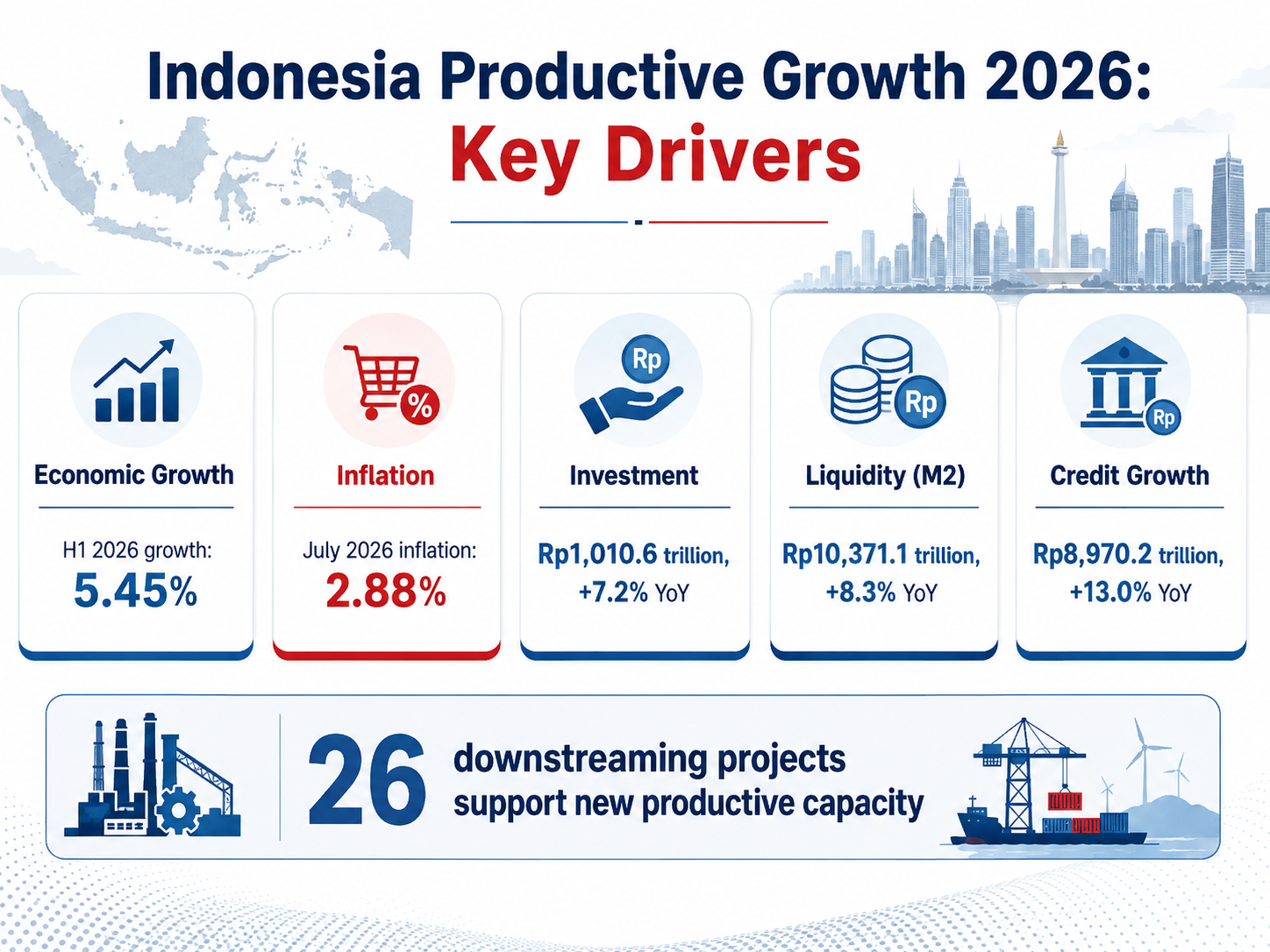
Indonesia’s economy grew 5.45% in the first half of 2026, while inflation remained contained at 2.88%. Investment realization reached Rp1,010.6 trillion, representing annual growth of 7.2%.
These indicators provide a stronger base for policies designed to expand production capacity, improve competitiveness, and create new sources of growth despite continued global uncertainty.
Credit Growth Accelerates Even as M2 Moderates
A notable feature of Indonesia Productive Growth 2026 is the relationship between liquidity and credit.
Broad money, or M2, reached Rp10,371.1 trillion in July 2026, growing 8.3% year on year. This was slightly slower than the 8.7% growth recorded in June.
However, bank lending accelerated to 13.0% year on year, reaching Rp8,970.2 trillion, up from 12.1% growth a month earlier.
This suggests that the key issue is not simply how quickly liquidity expands, but how effectively available funds are transmitted into financing for households, businesses, investment, and productive economic activity.
Liquidity Must Reach Productive Economic Activity
For Indonesia Productive Growth 2026, stronger credit becomes more meaningful when it supports investment and productive expansion.
M1 grew 10.0% year on year in July, while quasi-money growth slowed to 5.6%. Rupiah demand deposits also expanded faster, while growth in time deposits moderated.
These movements show changes in the composition of liquidity within the economy. The broader policy objective is to ensure that financial resources can support activity that increases productivity and domestic value creation.
Downstreaming Creates New Investment Channels
One major destination for productive financing is Indonesia’s downstream industrial agenda.
By 2026, the government had launched 26 downstreaming projects covering coal-to-DME processing, copper and gold, industrial salt, alumina-to-aluminium development, and waste-to-energy initiatives.
These projects are expected to create tens of thousands of jobs while strengthening Indonesia’s position in global supply chains and increasing domestic value added.
Strategic Assets Support Indonesia Productive Growth 2026
The government is also strengthening the management of strategic national assets.
Indonesia’s Gold Bank has managed around 153 tons of gold valued at approximately Rp360 trillion, while Danantara Sumber Daya Indonesia has managed US$14 billion in export proceeds from three strategic commodities and monitored thousands of export transactions.
At the same time, state-owned enterprise reform continues. The number of BUMN entities has been reduced, while total BUMN profit increased significantly from Rp186 trillion in 2024 to Rp326 trillion in 2025.
New Growth Engines Are Being Prepared for 2027
The next phase of Indonesia Productive Growth 2026 is increasingly linked to the government’s 2027 transformation agenda.
Planned initiatives include healthcare and school renovation, renewable energy expansion, asset optimization, financial-market development, and the planned Indonesia International Financial Center in Bali.
The broader objective is to increase production capacity, productivity, investment competitiveness, exports, and employment while moving toward stronger and more inclusive growth.
Key Takeaways
Indonesia Productive Growth 2026 is being shaped by the interaction between financial liquidity, credit expansion, investment, and structural transformation.
Although M2 growth has moderated, stronger credit provides an important channel for financing productive activity. The longer-term test will be whether that financing supports downstreaming, stronger domestic industries, productive employment, and new sources of sustainable growth.
For professional foreign-currency exchange, Cash X Change operates as an Authorized Money Changer, providing competitive and transparent exchange rates. For international remittances, Ditransferin facilitates money transfers and cash withdrawals through Western Union, helping individuals and businesses manage cross-border transactions securely.
Source: Investor Daily, August 20, 2026; Kontan, August 21, 2026