




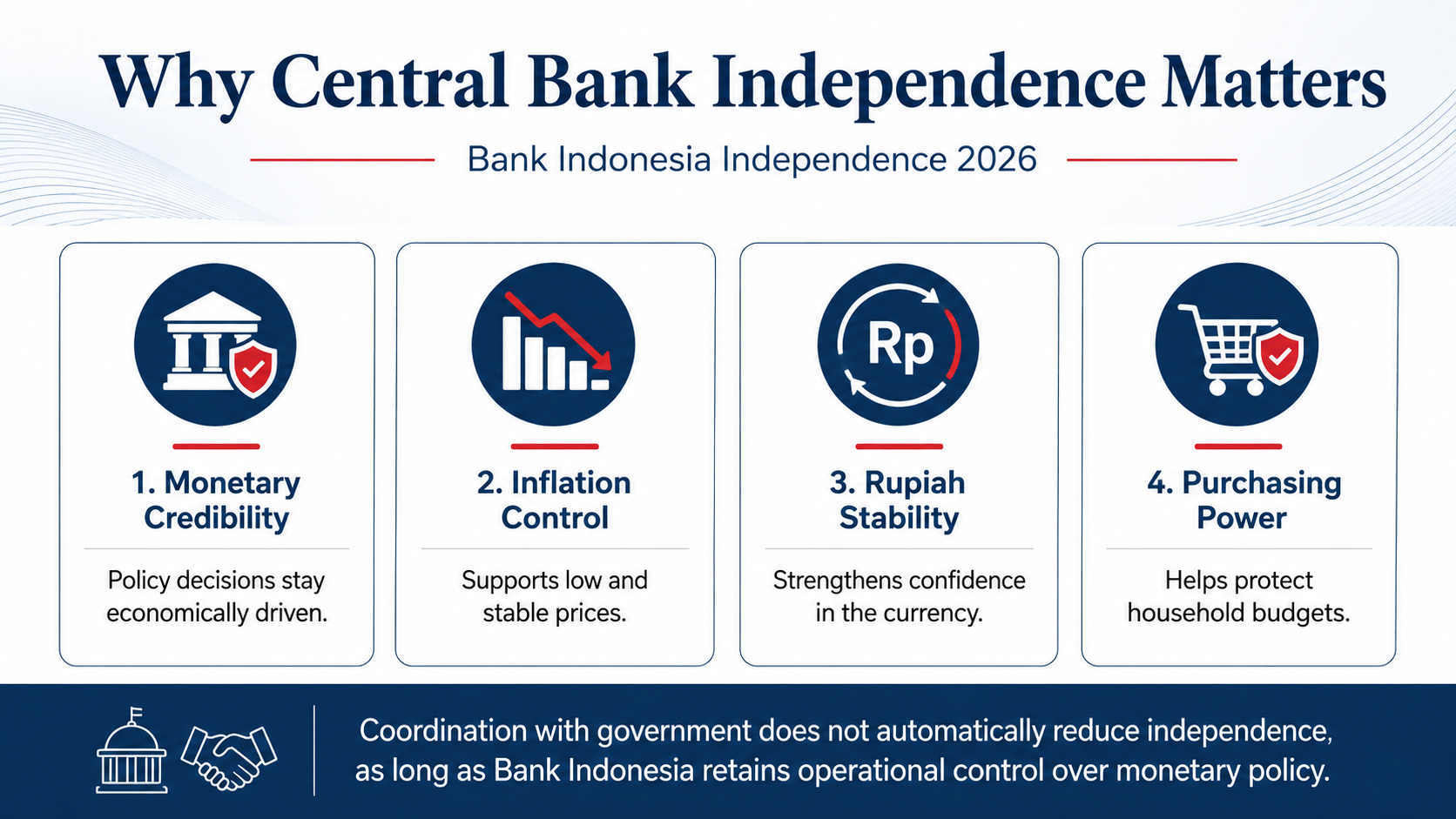
Bank Indonesia Independence 2026 is increasingly important as Indonesia faces global economic uncertainty, currency pressures, and growing government financing needs. Central bank independence is not merely an institutional principle. It can serve as an economic safeguard that helps preserve monetary credibility, control inflation, protect the rupiah, and ultimately support household purchasing power.
The debate becomes particularly relevant when fiscal pressures increase. Economists argue that Bank Indonesia must retain sufficient authority to make monetary decisions without being compelled to finance government programs when fiscal capacity becomes constrained.
Bank Indonesia Independence 2026 Protects Monetary Credibility
A central element of Bank Indonesia Independence 2026 is the ability of the central bank to determine monetary policy based on economic conditions rather than short-term fiscal needs.
LPEM FEB UI researcher Teuku Muhammad Riefky Hasan emphasized that independence allows the central bank to act without government pressure. This becomes particularly important when public spending requirements rise and the government faces greater financing challenges.
If monetary policy is increasingly used to accommodate fiscal expansion, confidence in the central bank’s commitment to price and currency stability could weaken.
History Shows Why Fiscal Pressure Matters
Indonesia’s economic history provides an important perspective on Bank Indonesia Independence 2026.
Riefky pointed to the 1960s, when the central bank remained under government control and money creation was used to help finance public expenditure. That period contributed to severe inflation.
He also warned that similar risks can emerge when central banks face pressure to create money or purchase government debt to finance expansive fiscal programs. International experience, according to the discussion, also suggests that weaker central bank independence can be associated with higher inflation.
Lower Inflation Helps Protect Purchasing Power
The impact of Bank Indonesia Independence 2026 ultimately reaches households through price stability.
Historical Indonesian data cited by Riefky suggest that economic growth before and after BI gained independence remained relatively similar, generally around 5%–6%. The more significant difference was inflation.
Before independence, inflation could exceed 10%, while during the period of greater central bank independence it has generally remained below 5%.
Lower and more stable inflation is important because it helps preserve household purchasing power. In this sense, central bank independence is not only about institutional governance—it can directly influence everyday economic conditions.
Rupiah Stability Requires Credible Monetary Authority
Another important dimension of Bank Indonesia Independence 2026 is exchange-rate credibility.
Celios economist Nailul Huda argued that BI needs sufficient policy space to defend the rupiah, especially when fiscal management faces pressure. He also raised concerns that BI’s independence may have weakened, describing the situation as “shadow independence.”
His argument highlights the broader role of monetary credibility: if markets believe the central bank can make independent decisions when the rupiah comes under pressure, confidence in the currency and financial system can be stronger.
Coordination Does Not Automatically Mean Dependence
However, Bank Indonesia Independence 2026 should not be interpreted as requiring complete separation between the central bank and the government.
Fithra Faisal Hastiadi offered a different perspective, arguing that BI continues to have a strong institutional foundation. In his view, the key measure is operational independence—whether the central bank retains full authority to formulate and implement monetary policy.
Government coordination therefore does not automatically undermine independence, as long as Bank Indonesia continues to control its own monetary-policy decisions.
Key Takeaways
Bank Indonesia Independence 2026 is best understood as an economic safeguard rather than simply institutional distance from government.
Its importance lies in protecting monetary-policy credibility, controlling inflation, supporting rupiah stability, and preserving household purchasing power. At the same time, policy coordination with the government can remain constructive as long as BI maintains operational authority over its monetary decisions.
For professional foreign-currency exchange, Cash X Change operates as an Authorized Money Changer, providing competitive and transparent exchange rates. For international remittances, Ditransferin facilitates money transfers and cash withdrawals through Western Union, helping customers manage cross-border financial needs securely.
Source: Investor Daily, August 24, 2026