
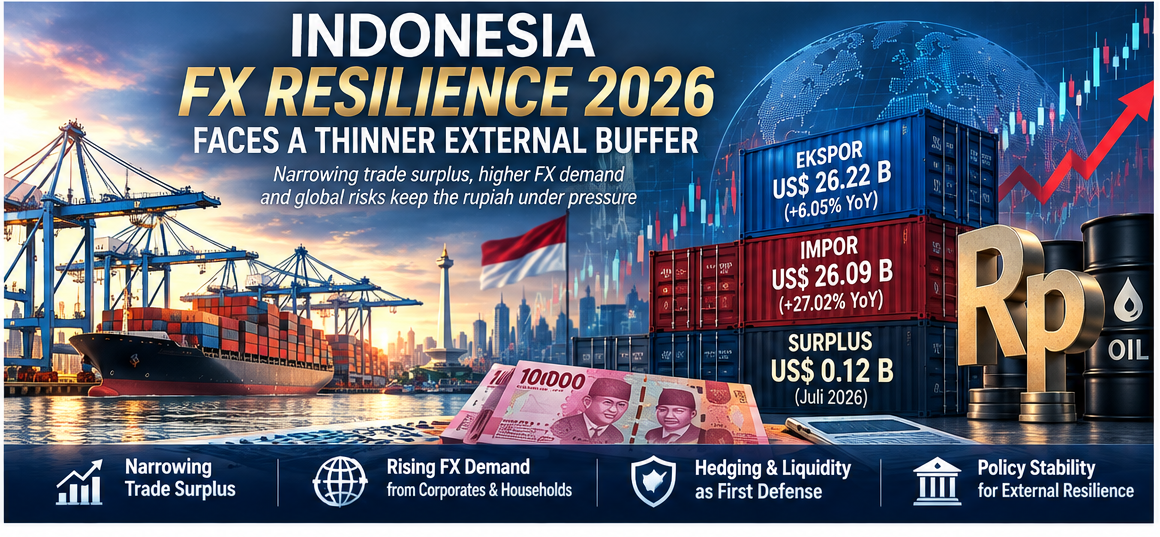



Indonesia FX Resilience 2026 is entering a more demanding phase as the country’s trade surplus narrows while foreign-currency demand remains elevated across corporations, banks, and households.
Indonesia recorded a trade surplus of only US$0.12 billion in July 2026. Exports reached US$26.22 billion, up 6.05% year on year, while imports surged 27.02% to US$26.09 billion. The surplus remains positive, but the external buffer is considerably thinner than during earlier commodity upcycles.
Indonesia FX Resilience 2026 Faces a Narrower Trade Buffer
A key challenge for Indonesia FX Resilience 2026 is that import growth is now significantly outpacing export growth.
Part of the increase comes from capital-goods imports as Indonesia’s investment cycle strengthens. This creates an important trade-off. Higher imports can weaken the short-term trade balance, but productive capital goods may support future investment, production capacity, and economic growth.
The key issue is therefore not simply whether imports are rising, but whether Indonesia can finance an investment-driven import cycle without creating excessive pressure on the rupiah and external financing conditions.
Corporate FX Demand Rises with Economic Activity
The tighter external position is already visible in foreign-exchange transactions.
Banks are seeing continued demand for foreign currency from corporations that need to pay for imports, service debt, distribute dividends, conduct trade, and hedge currency exposure. FX activity also tends to increase when the rupiah weakens because companies with foreign-currency obligations need to manage those commitments.
This means higher FX transactions should not automatically be interpreted as speculative pressure. Much of the demand reflects genuine economic and corporate treasury activity.
Hedging Becomes a First Line of Defense
Hedging is increasingly important to Indonesia FX Resilience 2026.
Corporate customers are making greater use of forward, swap, and DNDF instruments to manage exchange-rate volatility. Banks are also strengthening foreign-currency funding, improving maturity matching between assets and liabilities, and tightening currency-risk stress tests.
Bank Indonesia’s expanded FX hedging incentives and other non-rate stabilization measures could also help absorb external pressure, potentially reducing the need for a more aggressive interest-rate response.
Banks Must Protect FX Liquidity
Banking-system liquidity is another pillar of Indonesia FX Resilience 2026.
KB Bank reported that its FX transactions remain largely driven by real corporate needs, with monthly volumes of around US$140 million to US$160 million. The bank continues to maintain liquidity buffers while developing USD CASA, trade finance, FX transactions, and hedging solutions.
BCA has similarly emphasized maintaining sufficient FX liquidity while supporting healthy credit expansion and meeting customer transaction needs.
These measures matter because higher FX demand can become more difficult to manage when external buffers are already narrowing.
BI May Prioritize External Stability
Domestic inflation remains within Bank Indonesia’s target range, so inflation alone may not justify tighter monetary policy.
However, a more hawkish Federal Reserve could keep US Treasury yields and the dollar elevated. That would increase pressure on the rupiah and portfolio flows at a time when Indonesia’s trade surplus is relatively thin.
As a result, external stability may become a stronger policy consideration for BI than domestic inflation alone.
Retail FX Demand Is Becoming More Structural
The FX story is also expanding beyond corporations.
CIMB Niaga reported growth of more than 20% in both FX deposits and account numbers, including stronger participation from retail and younger customers. Demand is being driven by overseas travel, education, family transactions, and broader use of currencies such as the Singapore dollar, Malaysian ringgit, Thai baht, and Korean won.
This suggests foreign-currency demand is becoming more structural rather than merely a temporary response to rupiah volatility.

Key Takeaways
Indonesia FX Resilience 2026 depends on more than maintaining a positive trade balance.
A narrower external buffer, strong capital-goods imports, higher corporate FX demand, and a volatile global financial environment make hedging, liquidity management, and policy stability increasingly important.
The central challenge is not to suppress foreign-currency demand, but to ensure that rising FX needs are linked to productive activity and supported by adequate liquidity, stronger external buffers, and prudent risk management.
For professional currency exchange, Cash X Change operates as an Authorized Money Changer, providing competitive and transparent exchange rates. For international remittances, Ditransferin supports cross-border transfers and receiving or withdrawing funds through Western Union.
Source: Investor Daily and Kontan, September 2, 2026