




Indonesia Policy Credibility 2026 is becoming increasingly important as Bank Indonesia enters a new leadership period under Governor Destry Damayanti while global financial uncertainty remains elevated.
Destry has emphasized that domestic economic stability remains the foundation for stronger growth. Bank Indonesia expects economic growth to reach 5.4% in 2026 and 6% in 2027, but achieving those targets will require more than the right policy instruments. It will also depend on whether businesses, investors, and households trust the direction and consistency of policy.
Indonesia Policy Credibility 2026 Starts with Stability
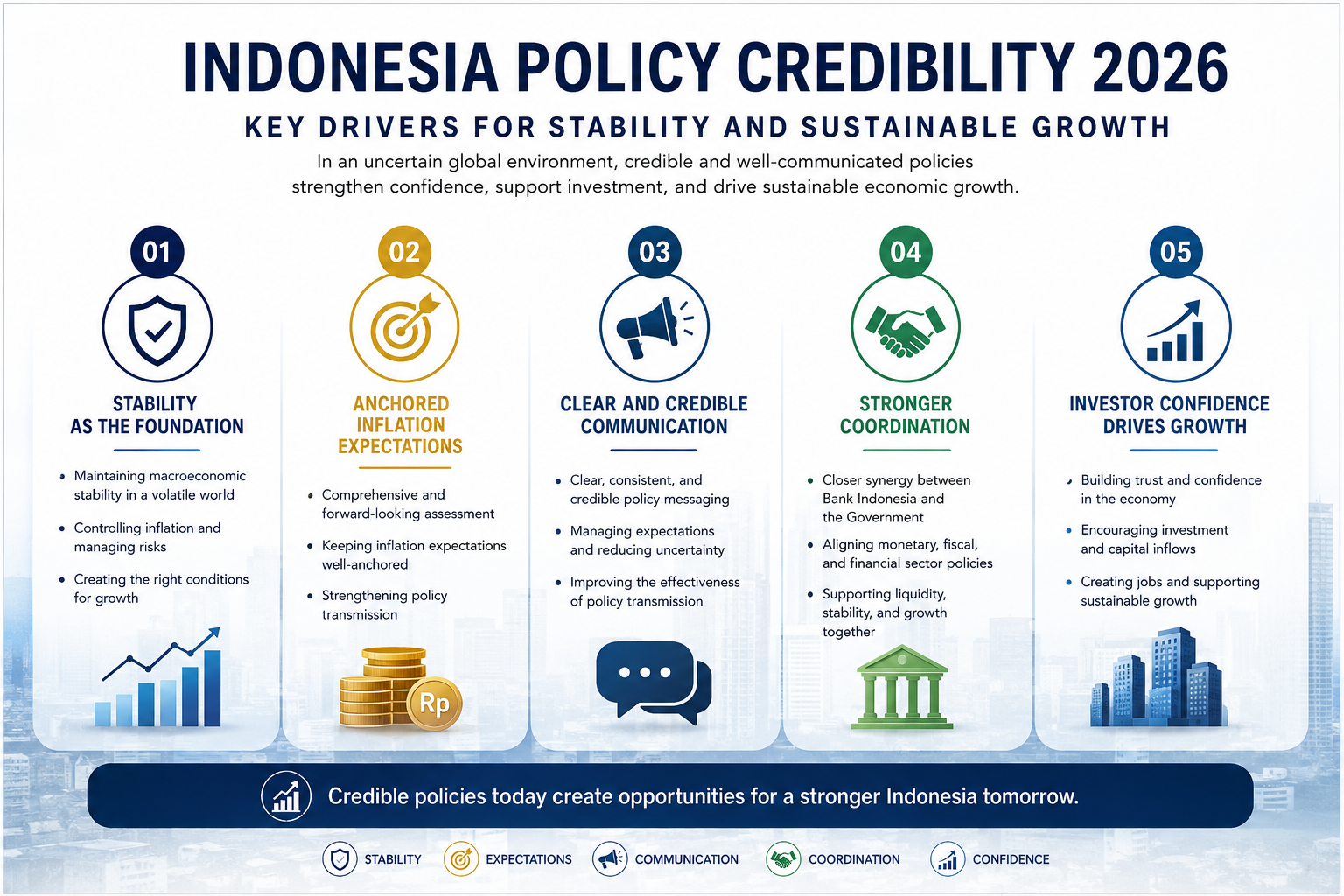
The foundation of Indonesia Policy Credibility 2026 is a policy framework that treats stability as a prerequisite for growth rather than as an opposing objective.
Destry has outlined a strategy based on impactful, inclusive, integrative, and synergistic policy, or “3I plus S.” She has also emphasized that Bank Indonesia cannot address domestic challenges such as inflation alone and must work closely with government ministries and other stakeholders.
That coordination is especially important because BI’s mandate under Law No. 4 of 2026 now extends beyond stability to supporting sustainable growth and employment creation.
Inflation Expectations Must Remain Anchored
A key element of Indonesia Policy Credibility 2026 is the management of expectations.
At the G20 Finance Ministers and Central Bank Governors Meeting, Bank Indonesia highlighted the importance of keeping inflation expectations anchored through comprehensive and forward-looking assessments.
This matters because inflation expectations can influence pricing decisions, wage negotiations, consumption, and investment even before actual inflation changes materially.
When households and businesses believe inflation will remain under control, monetary policy can work more effectively with less disruption to economic activity.
Clear Communication Becomes a Policy Instrument
Bank Indonesia also stressed that monetary-policy communication must be clear, consistent, and credible.
This is not merely a public-relations issue. In uncertain markets, communication itself becomes part of the transmission mechanism.
If markets understand how BI is assessing inflation, exchange-rate risks, liquidity, and global conditions, policy signals become easier to interpret. Consistent communication can reduce uncertainty, while conflicting or unclear signals may weaken confidence even before interest rates move.
Coordination Can Strengthen Market Confidence
Another important pillar of Indonesia Policy Credibility 2026 is stronger coordination between monetary and fiscal authorities.
Finance Minister Purbaya Yudhi Sadewa has expressed expectations for closer policy synchronization with BI, including through the Financial System Stability Committee and liquidity-related policy tools.
Such coordination can help ensure that monetary, fiscal, and financial-sector policies reinforce rather than contradict each other.
This does not mean eliminating institutional independence. Instead, effective coordination can reduce policy uncertainty while preserving clear responsibilities between institutions.
Digital Finance Makes Policy Transmission More Complex
The policy environment itself is also changing.
At the G20 meeting, BI noted that deeper global financial integration and rapid digitalization require monetary-policy frameworks to remain adaptive. Policy coordination must increasingly connect monetary policy, exchange-rate stabilization, macroprudential measures, and payment systems.
The G20 also highlighted artificial intelligence as a potential source of productivity and new growth, while emphasizing the need for stronger financial-system resilience and cybersecurity.
This means credibility increasingly depends not only on traditional monetary tools, but also on the ability of institutions to adapt to technological and financial change.
Investor Confidence Connects Stability with Growth
Ultimately, Indonesia Policy Credibility 2026 matters because confidence affects real economic decisions.
BRI President Director Hery Gunardi has argued that stronger growth and investment could improve investor expectations and encourage capital flows to return to Indonesia.
This creates an important link between policy credibility and economic performance.
Stable policy can strengthen confidence. Stronger confidence can support investment. More investment can then reinforce growth.
Key Takeaways
Indonesia Policy Credibility 2026 will be tested not only by whether Bank Indonesia chooses the right policy instruments, but also by whether those policies remain understandable, consistent, coordinated, and trusted.
In an environment shaped by geopolitical tension, trade uncertainty, inflation risks, high debt, and financial-market volatility, credibility can become an economic asset in its own right.
For professional foreign-currency exchange, Cash X Change operates as an Authorized Money Changer, providing competitive and transparent exchange rates. For international remittances, Ditransferin supports cross-border transfers and receiving or withdrawing funds through Western Union, helping customers manage international financial needs securely and conveniently.
Source: Investor Daily and Kontan, September 3, 2026