




Asia Risk Appetite 2026 is improving as expectations for another US interest-rate increase begin to soften, giving regional equities and currencies temporary relief from earlier pressure.
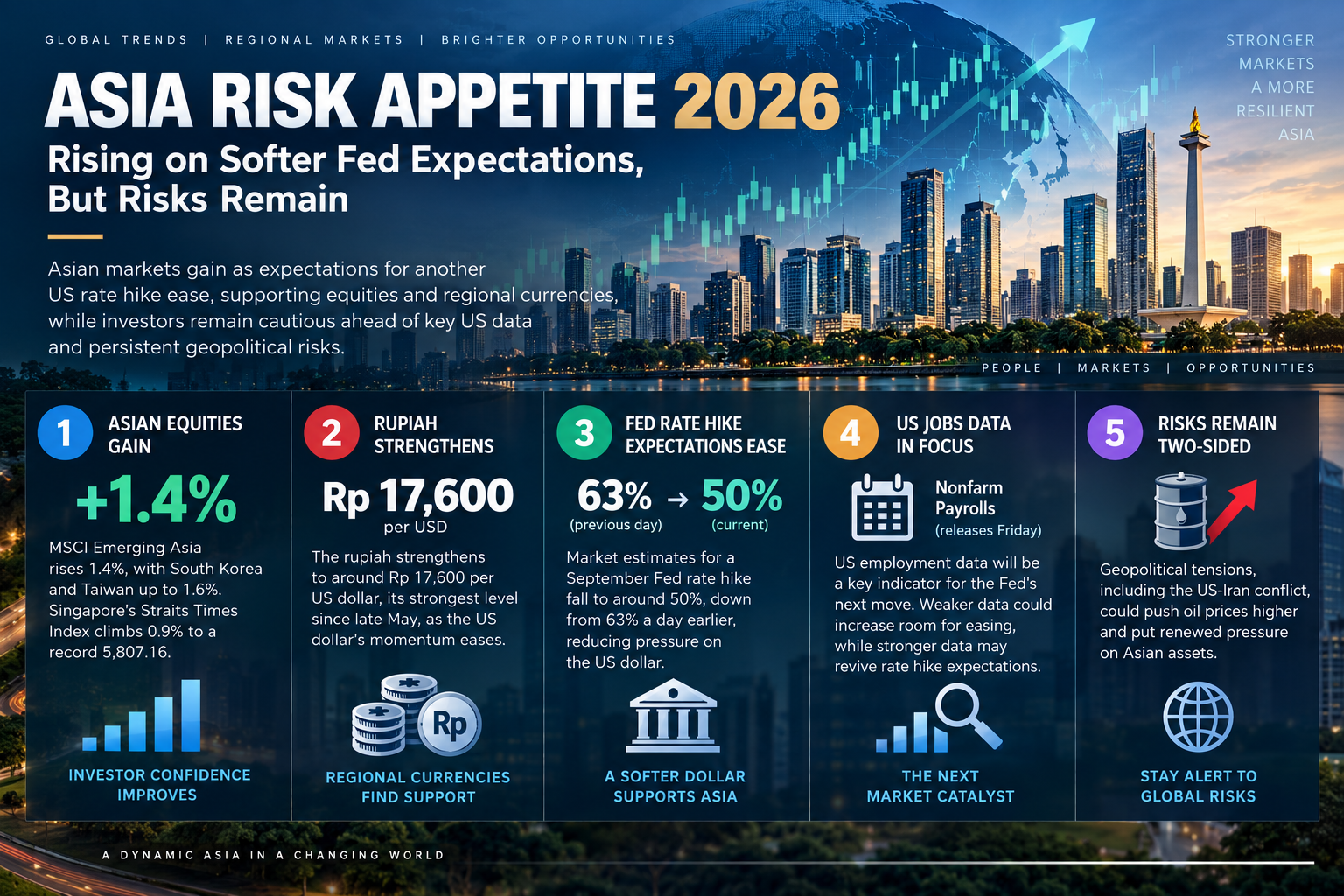
Asian markets strengthened on September 4, 2026, as investors reassessed the likelihood of further Federal Reserve tightening. The MSCI emerging Asia equity index rose 1.4%, while technology-heavy markets in South Korea and Taiwan gained as much as 1.6%. Singapore’s Straits Times Index also climbed to a record 5,807.16.
Asia Risk Appetite 2026 Rises as Fed Expectations Shift
The current improvement in Asia Risk Appetite 2026 is being driven primarily by changing expectations around US monetary policy.
Markets now estimate the probability of a Fed rate increase in September at around 50%, down from roughly 63% a day earlier. That shift has reduced some pressure on the US dollar and encouraged investors to move back into risk assets.
The key point is that the rally is being driven by repricing rather than by a dramatic improvement in regional economic fundamentals.
A Softer Dollar Supports Regional Currencies
Currencies have benefited alongside equities.
The rupiah strengthened to around Rp17,600 per US dollar, its strongest level since late May. The Thai baht also firmed to 32.87 per dollar, while the Korean won and Taiwan dollar posted modest gains.
For Asia Risk Appetite 2026, this shows how quickly currency sentiment can improve when expectations for US rate pressure ease.
However, the rupiah remains one of the weaker emerging-market currencies on a year-to-date basis. This means short-term relief should not yet be interpreted as a structural recovery.
Equities Benefit from Lower US Rate Pressure
Equity markets are also responding positively to the change in rate expectations.
Lower US yields can make Asian assets relatively more attractive and reduce some pressure on capital flows. That effect was visible across regional markets, especially in Korea, Taiwan, Singapore, and the broader ASEAN index.
The response highlights how sensitive regional markets remain to global monetary conditions.
When investors believe the Fed is less likely to tighten aggressively, risk appetite can recover quickly.
US Jobs Data Becomes the Next Major Trigger
The durability of Asia Risk Appetite 2026 will depend heavily on upcoming US labor-market data.
Investors are waiting for the nonfarm payrolls report because it could influence whether the Federal Reserve maintains its current stance or moves toward further tightening or eventual easing.
If employment data shows weaker economic momentum, expectations for a more cautious Fed may strengthen. That could support Asian equities and currencies.
Conversely, stronger-than-expected data could revive concerns about higher US rates and reverse part of the current rally.
Oil and Geopolitics Keep Risks Two-Sided
Monetary policy is not the only risk.
DBS economist Radhika Rao warned that renewed US-Iran tensions could push oil prices higher and place fresh pressure on Asian assets.
That creates a clear transmission channel:
Geopolitical tension → higher oil prices → stronger inflation pressure → more hawkish Fed expectations → stronger dollar → weaker Asian risk assets.
For energy-importing economies, higher oil prices could also add pressure to trade balances, inflation, and currencies.
Short-Term Relief Is Not Yet a Structural Recovery
The broader message behind Asia Risk Appetite 2026 is that current gains remain conditional.
Regional markets are benefiting from softer expectations for US tightening, but the underlying environment is still shaped by inflation, high energy prices, geopolitical tension, and uncertainty around global growth.
The current rebound is therefore better understood as a window of relief rather than confirmation of a lasting trend.
Key Takeaways
Asia Risk Appetite 2026 is strengthening as investors reduce expectations for another immediate Fed rate increase.
Asian equities and currencies are benefiting from a softer dollar and lower perceived rate pressure, while US jobs data will be the next major test for market sentiment.
At the same time, geopolitical tensions and oil-price risks mean the rally remains fragile. The durability of the recovery will depend on whether favorable monetary expectations can survive incoming economic data and renewed inflation risks.
For professional foreign-currency exchange, Cash X Change operates as an Authorized Money Changer, providing competitive and transparent exchange rates. For international remittances, Ditransferin supports cross-border transfers and receiving or withdrawing funds through Western Union, helping customers manage international financial needs securely and conveniently.
Source: Kontan, September 4, 2026