



US Dollar Outlook 2026 is being shaped by more than Federal Reserve policy alone. Recent market developments show that long-term Treasury yields, government bond buybacks, fiscal financing concerns, and global capital flows are becoming increasingly important drivers of the US currency.
The dollar has remained near multi-month lows as investors reassess the implications of higher long-term yields and the US Treasury’s decision to increase buybacks of longer-dated bonds. At the same time, markets are monitoring geopolitical developments, trade tensions, and upcoming policy signals from the Federal Reserve and Bank of Japan.
US Dollar Outlook 2026 Faces Treasury Yield Pressure
One of the main forces shaping US Dollar Outlook 2026 is the rise in long-term government bond yields.
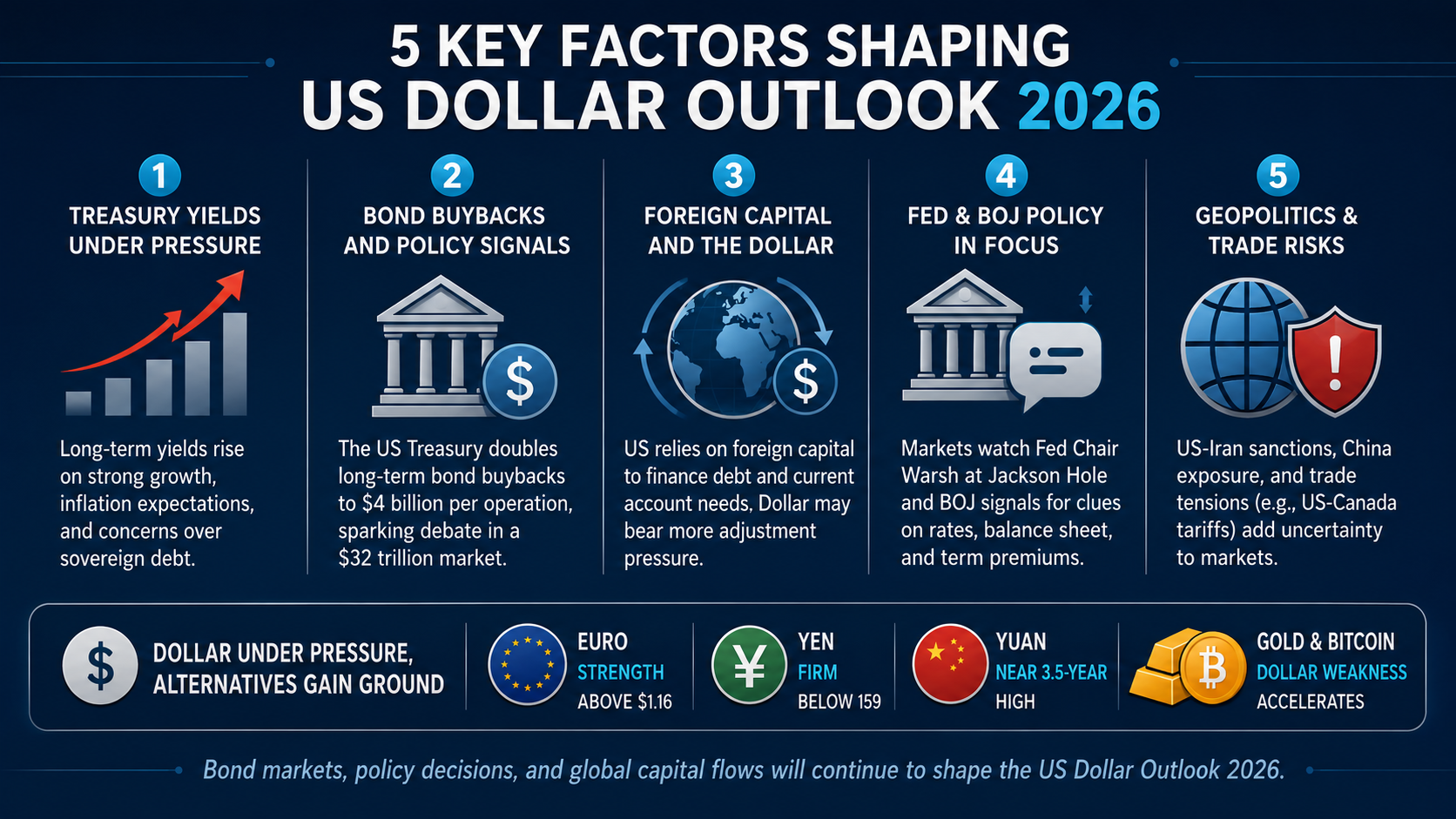
Long-term yields have climbed globally amid stronger growth expectations, higher inflation expectations, and concerns about expanding sovereign debt. In the United States, the 30-year Treasury yield recently reached its highest level in almost two decades.
This matters for the dollar because higher yields normally increase the attractiveness of US assets. However, the current situation is more complex because markets are also questioning how policymakers will manage rising borrowing costs.
Why US Treasury Buybacks Matter for the Dollar
A key development for US Dollar Outlook 2026 is the Treasury Department’s decision to double long-term bond buybacks to US$4 billion per operation.
The amount remains relatively small compared with the approximately US$32 trillion Treasury market. Even so, the policy signal has attracted attention because traders are assessing whether authorities are becoming more active in managing long-term bond-market conditions.
Concerns that official actions could limit downward pressure on long-duration securities have contributed to weaker dollar sentiment.
This creates an unusual dynamic: efforts to stabilize the bond market may shift some of the adjustment pressure toward the currency.
Foreign Capital Becomes Part of the Currency Equation
The relationship between foreign capital and US Dollar Outlook 2026 is also becoming more important.
The United States relies on continued demand for its financial assets, particularly as fiscal borrowing and current-account financing needs remain significant.
If investors become less willing to absorb long-duration debt at existing prices, policymakers may face difficult trade-offs between bond yields, capital inflows, and currency valuation.
This is why developments in the Treasury market are increasingly relevant to foreign-exchange investors, rather than being viewed purely as a fixed-income issue.
Fed Communication Could Reshape Long-Term Yields
Monetary-policy communication remains another major factor for US Dollar Outlook 2026.
Markets are closely watching Federal Reserve Chair Kevin Warsh’s Jackson Hole remarks for signals on interest rates, the balance sheet, duration supply, and term premiums.
Strategists cited in the source suggest that comments on these structural bond-market issues could influence long-term yields as much as, or even more than, some economic data releases.
At the same time, investors are also monitoring Bank of Japan signals, particularly whether policymakers could move closer to another rate increase.
Geopolitical and Trade Risks Add Another Layer
The US Dollar Outlook 2026 is also being influenced by geopolitical and trade uncertainty.
Markets are awaiting further details on potential US sanctions against Iran, including whether additional measures could affect China.
Trade tensions are also visible elsewhere. The Canadian dollar weakened after negotiations with the United States failed and both sides imposed 50% tariffs on selected goods.
These developments can influence global risk appetite, capital flows, and demand for major currencies.
Other Currencies Gain Ground as Dollar Momentum Fades
Pressure on the dollar has coincided with relative strength in several other currencies and assets.
The euro remained above US$1.16, the yen held relatively firm, and the yuan traded near its strongest level in around 3.5 years after eight consecutive weeks of gains.
The dollar also recorded notable weakness against gold and bitcoin, highlighting broader investor reassessment of the currency’s relative attractiveness.
Key Takeaways
US Dollar Outlook 2026 is increasingly influenced by the interaction between bond yields, Treasury policy, fiscal financing, Federal Reserve communication, geopolitical risks, and foreign capital flows.
The current weakness of the dollar is therefore not simply a question of the next interest-rate decision. It also reflects how investors view the sustainability of long-term US borrowing costs and the credibility of policies designed to manage financial-market pressure.
For professional foreign-currency exchange, Cash X Change operates as an Authorized Money Changer, providing competitive and transparent exchange rates. For international remittances, Ditransferin facilitates money transfers and cash withdrawals through Western Union, helping customers manage cross-border financial needs securely.
Source: Kontan, August 24, 2026