




Indonesia Growth Quality 2026 is entering a more demanding phase as inflationary pressure begins to rise while the economy increasingly depends on stronger private investment and productive expansion. Indonesia remains resilient, but the next challenge is not simply maintaining growth. It is ensuring that growth improves productivity, creates better jobs, protects purchasing power, and supports stronger household income.
Inflation in August is expected to rise to 3.31% year on year from 2.88% in July. At the same time, Great Institute maintains its 2026 growth projection at 5.3%–5.6%, but argues that achieving this range will depend increasingly on investment and private-sector expansion during the second half of the year.
Indonesia Growth Quality 2026 Faces Rising Inflation
A key challenge for Indonesia Growth Quality 2026 is the return of stronger price pressure.
August inflation is projected at 0.33% month on month, reversing the 0.14% deflation recorded in July. Core inflation is also expected to rise to 2.98% year on year from 2.76%.
Food prices are among the main drivers, particularly chicken and chili. Gold prices are also contributing to core inflation.
Looking ahead, high oil prices and weather disruptions associated with El Niño could create additional pressure through higher production costs and weaker food supply.
Purchasing Power Becomes an Important Growth Test
The impact of inflation on Indonesia Growth Quality 2026 goes beyond headline price data.
Higher food and energy costs can reduce household purchasing power and weaken consumption. This matters because household spending was one of the major supports for economic growth during the first half of 2026.
If inflation continues to rise, stronger investment will become even more important in supporting income growth, employment, and economic capacity.
Investment Must Take a Bigger Role in Semester II
The next phase of Indonesia Growth Quality 2026 will depend increasingly on the private sector.
Investment realization reached Rp1,010.6 trillion in the first half of 2026, up 7.2% year on year. Investment credit grew 23.1% annually in July, while working-capital credit increased 11.6%.
However, Great Institute emphasizes that the real issue is no longer simply whether financing is available. The more important question is whether funding actually becomes private capital expenditure, production-capacity expansion, and job creation.
Financing Must Become Productive Capacity
For Indonesia Growth Quality 2026, strong credit growth becomes valuable only when it translates into productive economic activity.
Government policy therefore needs to reduce investment barriers, provide regulatory certainty, accelerate projects, and ensure liquidity reaches sectors capable of increasing output and productivity.
This marks an important transition from simply supporting demand toward strengthening the supply side of the economy.
From Spending More to Spending Better
Another important element of Indonesia Growth Quality 2026 is the changing role of fiscal policy.
Great Institute argues that government policy should gradually shift from providing direct economic impulses toward becoming a catalyst for broader private-sector activity.
Public spending remains necessary for purchasing power, basic services, and development. However, after significant fiscal support during the first half, the emphasis should increasingly move from “spending more” to “spending better.”
Confidence Becomes a Growth Asset
Confidence may ultimately determine whether Indonesia Growth Quality 2026 can maintain momentum.
Policy uncertainty or declining institutional credibility can encourage households to delay spending, businesses to postpone investment, and financial markets to demand higher risk premiums.
Conversely, consistent policies, trusted data, and credible institutions can encourage longer-term decisions and stronger private-sector expansion.
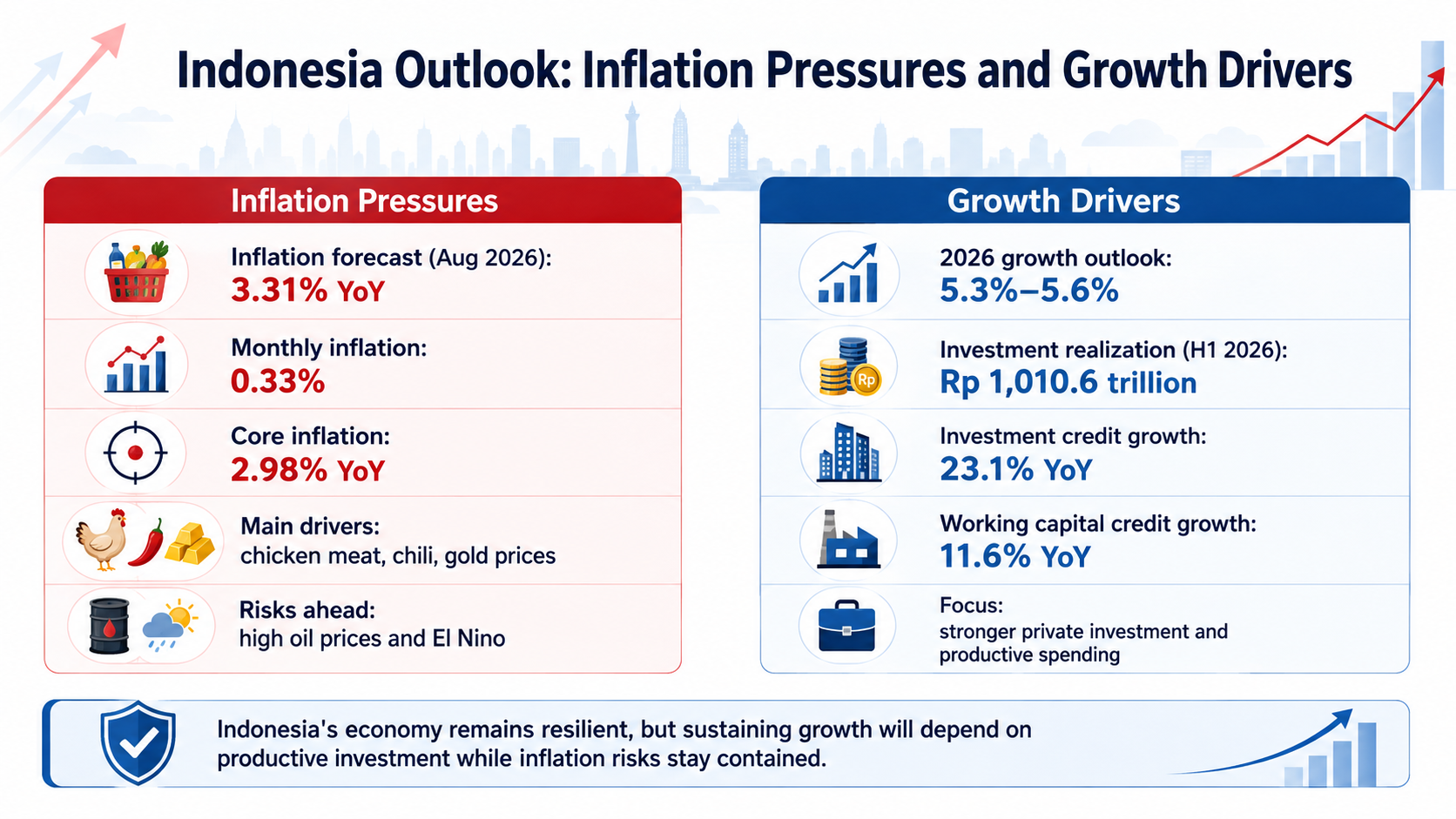
Key Takeaways
Indonesia Growth Quality 2026 will depend on balancing inflation control with stronger productive investment.
Rising food prices, oil costs, and El Niño risks could pressure purchasing power, while investment and credit need to translate into productivity, jobs, and stronger income. The quality of policy, regulation, and institutional credibility will therefore be as important as the amount of financing available.
For professional foreign-currency exchange, Cash X Change operates as an Authorized Money Changer, providing competitive and transparent exchange rates. For international remittances, Ditransferin facilitates money transfers and cash withdrawals through Western Union, helping customers manage cross-border financial needs securely.
Source: Kontan and Investor Daily, August 31, 2026