




Indonesia Shock Transmission 2026 is becoming a broader economic challenge as pressure on the rupiah begins to interact with energy prices, food risks, liquidity conditions, and global funding costs.
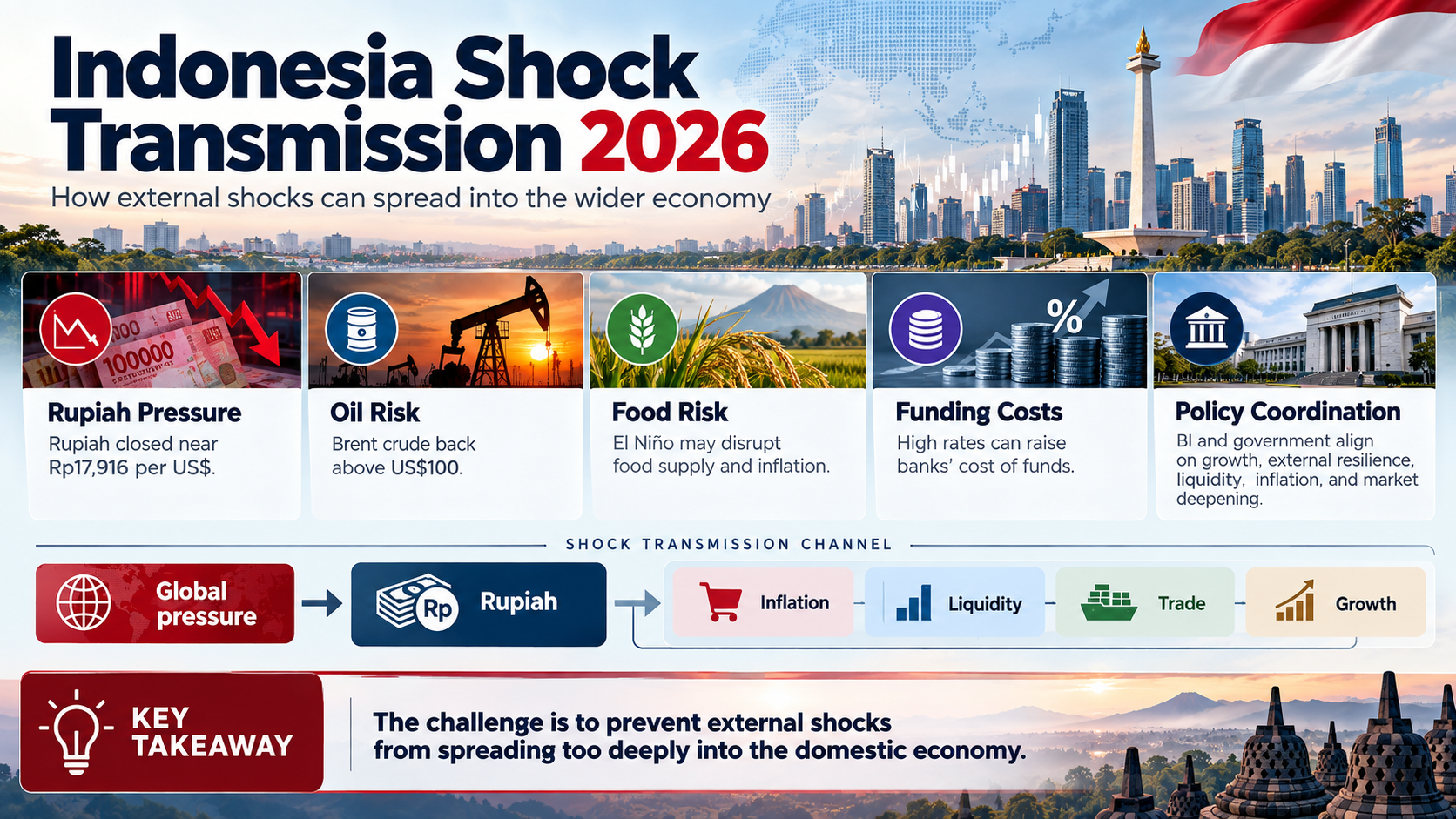
The rupiah closed at Rp17,916 per US dollar on September 24, weakening 0.55%, while JISDOR fell 0.53% to Rp17,898. The currency is expected to remain volatile as external pressure combines with domestic economic risks.
The issue is therefore no longer simply whether the rupiah can withstand global volatility. The more important question is whether policymakers can prevent those shocks from spreading into inflation, financing costs, trade, and economic growth.
Indonesia Shock Transmission 2026 Goes Beyond the Rupiah
The first layer of Indonesia Shock Transmission 2026 comes from external markets.
Brent crude has moved back above US$100 per barrel following renewed geopolitical tensions in the Middle East. At the same time, higher global yields and continued dollar strength are placing additional pressure on emerging-market currencies.
These conditions can affect Indonesia through several channels at once. Higher energy costs can influence imports and inflation, while tighter global financial conditions can increase pressure on capital flows and domestic funding.
Oil and Food Risks Create Two Inflation Channels
Energy is not the only concern.
El Niño could disrupt food production and supply, creating another potential source of inflation pressure. This means Indonesia may face both an external energy shock and a domestic food-supply shock.
For Indonesia Shock Transmission 2026, that combination matters because inflation can become the bridge between global market volatility and household purchasing power.
This is why inflation management requires coordination beyond interest-rate policy alone.
Why Rupiah Weakness Can Spread into the Real Economy
A weaker currency can raise the local cost of imported goods and commodities.
If that pressure persists alongside expensive energy and food disruptions, businesses may face higher input costs while consumers experience weaker purchasing power.
Analysts cited in the source also raised risks that upcoming domestic indicators could weaken, including the trade balance, manufacturing PMI, foreign-exchange reserves, and consumer confidence. These remain forecasts rather than confirmed outcomes, but they illustrate how currency and external-market pressure could spread into broader economic activity.
That makes Indonesia Shock Transmission 2026 fundamentally a transmission problem rather than only a foreign-exchange problem.
Five Policy Pillars Act as Economic Firewalls
Bank Indonesia and the Ministry of Finance are responding through five areas of policy coordination: economic growth, external-sector resilience, liquidity, inflation control, and financial-market deepening.
These pillars can be viewed as different economic firewalls.
Growth coordination seeks to preserve economic momentum. External-sector policy includes incentives for hedging instruments, DNDF, and Local Currency Transactions to strengthen capital flows and resilience.
Inflation coordination is supported through central and regional inflation-control teams, while financial-market deepening aims to improve policy transmission and broaden sources of financing.
Liquidity Coordination Limits High-Rate Spillovers
Liquidity is another important part of Indonesia Shock Transmission 2026.
Bank Indonesia has highlighted the risk of high deposit rates raising banks’ cost of funds. If funding costs increase too far, the pressure can eventually reach lending rates and make financing more expensive for businesses and households.
Coordination with the government therefore aims to prevent a global high-rate environment from unnecessarily tightening domestic financial conditions.
This creates a transmission chain policymakers want to limit:
higher global rates → funding competition → higher cost of funds → more expensive credit → weaker growth.
External Resilience Requires More Than Interest Rates
The policy response also goes beyond the BI-Rate.
BI continues to support external resilience through hedging incentives, capital-flow measures, DNDF, and Local Currency Transactions. These instruments are designed to strengthen the financial system’s ability to manage foreign-exchange exposure without placing the entire burden on interest rates.
For Indonesia Shock Transmission 2026, this broader toolkit becomes important when several shocks emerge simultaneously.
Key Takeaways
Indonesia Shock Transmission 2026 is ultimately about preventing market volatility from becoming wider economic instability.
Rupiah pressure, oil above US$100, food-supply risks, global yields, and funding costs can interact through inflation, liquidity, trade, and credit channels.
The five-pillar coordination between Bank Indonesia and the government therefore represents more than currency defense. It is an effort to prevent external shocks from spreading too deeply into Indonesia’s domestic economy.
For professional foreign-currency exchange, Cash X Change operates as an Authorized Money Changer, providing competitive and transparent exchange rates. For international remittances, Ditransferin supports cross-border transfers and receiving or withdrawing funds through Western Union.
Source: Kontan and Investor Daily, September 25, 2026