




Rupiah Relief 2026 is emerging as the Indonesian currency strengthens against the US dollar, but the recent rebound should not yet be interpreted as a complete reversal of the rupiah’s broader weakness this year.
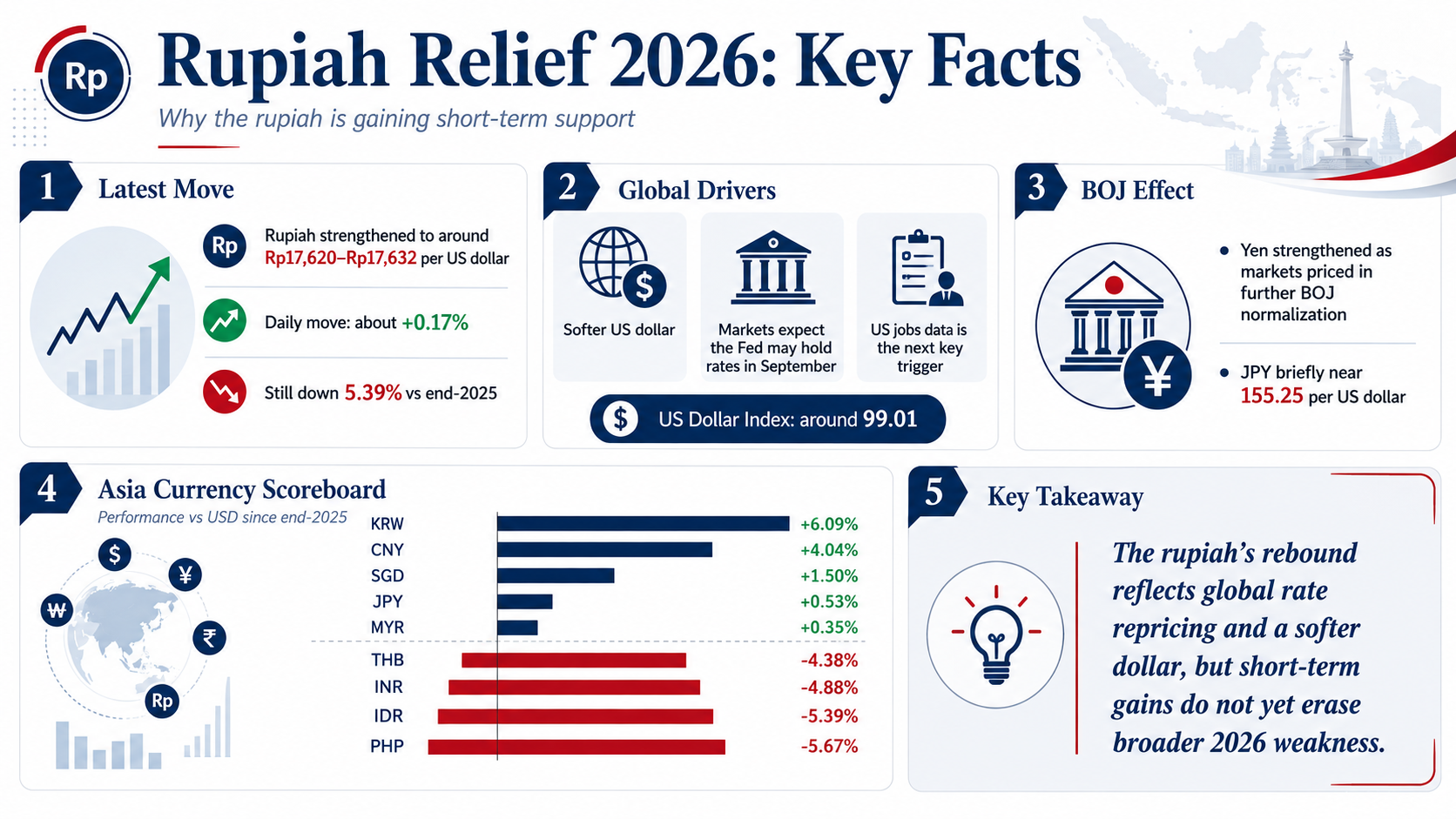
On September 4, 2026, the rupiah strengthened to around Rp17,620–Rp17,632 per US dollar in early trading. The move came as the US dollar softened and market expectations shifted toward the possibility that the Federal Reserve could keep interest rates unchanged at its September meeting.
Rupiah Relief 2026 Starts with a Softer Dollar
A key driver of Rupiah Relief 2026 is the changing outlook for US monetary policy.
The dollar has lost some support as investors reassess the likelihood of further Fed tightening. This has created more breathing room for several Asian currencies, including the rupiah and Philippine peso.
However, this short-term improvement needs context. Despite the recent gains, the rupiah remains about 5.39% weaker than its end-2025 level of Rp16,670 per US dollar.
That means the current rebound reflects relief rather than a confirmed long-term recovery.
Fed Expectations Give Asian Currencies More Room
The next phase of Rupiah Relief 2026 will depend heavily on incoming US economic data.
Markets are closely watching the US nonfarm payrolls report because labor-market conditions can influence the Federal Reserve’s rate outlook. If employment data weakens further, expectations for a more cautious Fed could increase, potentially reducing support for the dollar.
On the other hand, stronger-than-expected US data could quickly revive expectations of tighter policy and place renewed pressure on emerging-market currencies.
This illustrates how sensitive the rupiah remains to global interest-rate expectations.
BOJ Normalization Changes the Regional FX Landscape
The global currency story is no longer driven by the Federal Reserve alone.
Investor Daily reported that the Japanese yen strengthened as markets increasingly expected the Bank of Japan to maintain a more hawkish stance and continue policy normalization into 2027. The yen briefly traded near 155.25 per US dollar before stabilizing around 155.71.
This matters because Rupiah Relief 2026 is developing within a broader environment of monetary-policy divergence.
If the Fed becomes more cautious while the BOJ continues normalizing policy, global capital flows and currency valuations across Asia could shift further.
Asian Currency Performance Is Becoming More Uneven
Asia is not moving as a single currency bloc.
Since the end of 2025, the Korean won has strengthened around 6.09%, while the Chinese yuan has gained 4.04%. The Singapore dollar, Japanese yen, and Malaysian ringgit have also appreciated.
By contrast, the Thai baht, Indian rupee, rupiah, and Philippine peso remain weaker against the dollar.
This divergence shows that global dollar movements are only part of the story. Domestic fundamentals, interest-rate expectations, capital flows, and central-bank credibility continue to influence how individual Asian currencies perform.
Daily Gains Do Not Erase Year-to-Date Weakness
For Rupiah Relief 2026, the distinction between short-term movement and structural recovery is important.
A few stronger trading sessions can improve sentiment, but they do not automatically erase months of depreciation.
The rupiah’s recent gains are better understood as a repricing of global interest-rate expectations. A more durable recovery would likely require continued external stability, supportive capital flows, and a global environment that does not push the dollar sharply higher again.
Key Takeaways
Rupiah Relief 2026 reflects a temporary improvement in global currency conditions rather than the disappearance of Indonesia’s exchange-rate risks.
A softer dollar, changing Fed expectations, and a more hawkish Bank of Japan are reshaping the regional FX landscape. At the same time, uneven performance across Asian currencies shows that domestic fundamentals still matter.
The key question is whether the current relief can develop into a more sustained recovery once markets receive clearer signals from US economic data and major central banks.
For professional foreign-currency exchange, Cash X Change operates as an Authorized Money Changer, providing competitive and transparent exchange rates. For international remittances, Ditransferin supports cross-border transfers and receiving or withdrawing funds through Western Union, helping customers manage international financial needs securely and conveniently.
Source: Kontan and Investor Daily, September 4, 2026