



Rupiah Repricing Balance 2026 is beginning to take shape as the rupiah rebounds even while the US dollar remains close to its strongest level in two months.
On September 23, 2026, the rupiah opened around Rp17,844 per US dollar, strengthening 0.22% after closing weaker in the previous session. The US Dollar Index, meanwhile, remained firm at around 100.64.
The move suggests that the rupiah’s rebound is not being driven by broad dollar weakness. Instead, markets may be entering a phase where some of the hawkish global policy expectations have already been reflected in prices.
Rupiah Repricing Balance 2026 Creates a Fragile Rebound
The key feature of Rupiah Repricing Balance 2026 is the contrast between short-term relief and persistent longer-term pressure.
The dollar remains supported by expectations that major central banks will keep monetary policy tight. However, market pricing may already be more aggressive than the Federal Reserve’s own projections.
This creates an important shift.
The dollar may now need fresh economic data or additional policy signals to justify another significant move higher. Without that confirmation, some of the upward pressure on the dollar could become more limited.
The Dollar May Need New Evidence to Move Higher
This distinction is important for Rupiah Repricing Balance 2026.
Markets are no longer simply reacting to expectations of tighter policy. They are beginning to ask whether those expectations can be validated by upcoming data.
That changes the risk balance for emerging-market currencies.
If US inflation, labor-market data, or Fed communication fail to support even more tightening, the dollar may have less room to strengthen from already elevated levels.
For the rupiah, this does not guarantee a sustained recovery, but it may create temporary breathing room.
Lower Oil Prices Remove One Inflation Pressure
Oil is another important variable.
Brent crude moved to around US$99.22 per barrel as markets reacted to hopes of diplomatic progress in the US-Iran conflict.
This matters because higher energy prices had previously contributed to global inflation concerns and strengthened expectations of further monetary tightening.
For Rupiah Repricing Balance 2026, lower oil prices can therefore reduce one source of external pressure.
The effect is indirect but meaningful: softer energy prices can ease inflation concerns, reduce the urgency for additional rate hikes, and improve sentiment toward currencies exposed to global risk conditions.
Asian Currencies Show Mixed but Improving Momentum
The rupiah was not the only Asian currency to strengthen.
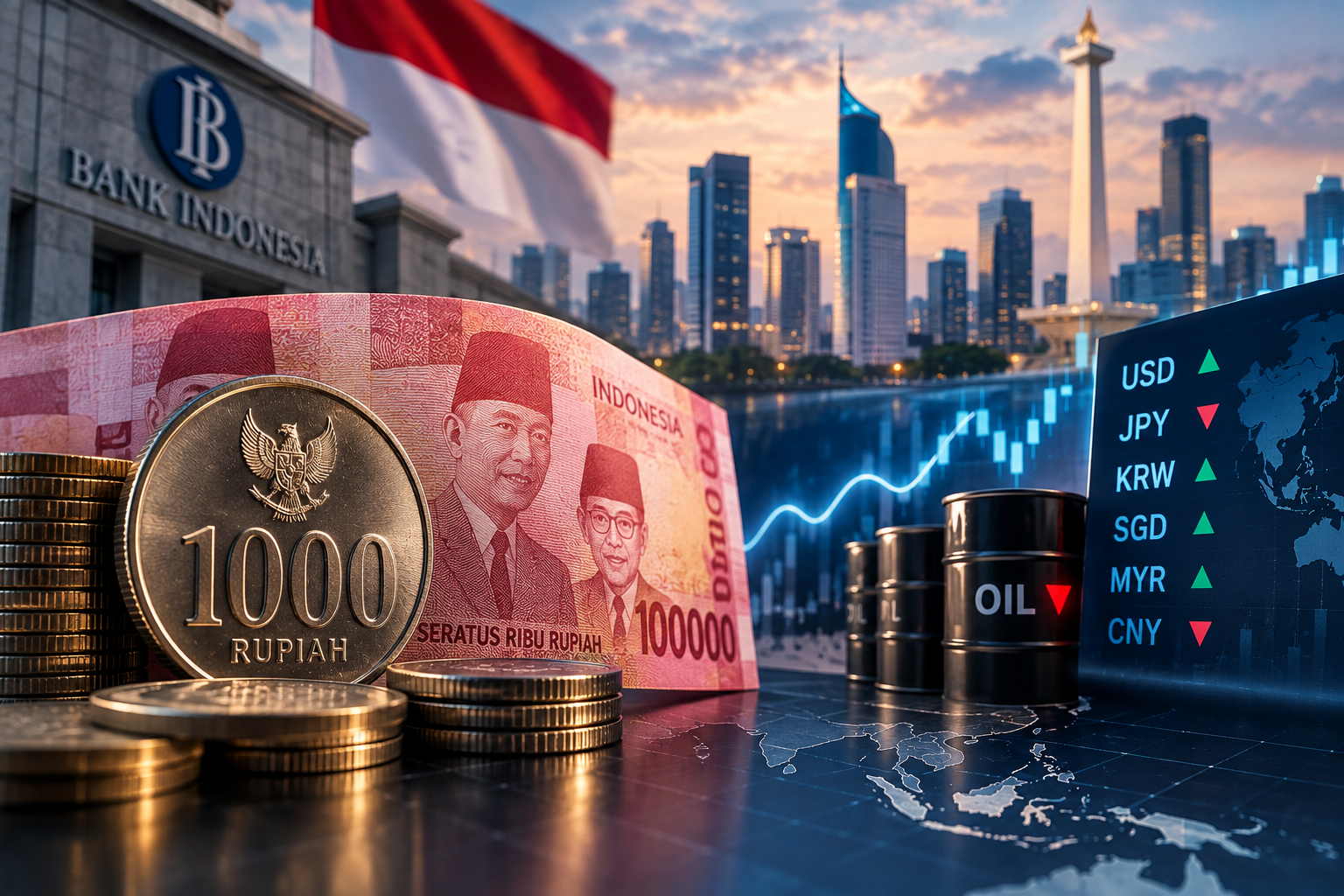
The Korean won, Taiwan dollar, Malaysian ringgit, and Singapore dollar also posted gains, while the Japanese yen, Thai baht, Philippine peso, and Chinese yuan weakened.
This mixed performance shows that Asian currencies are still moving selectively rather than as one regional bloc.
That selectivity remains important because investors are increasingly differentiating between markets based on monetary policy, capital flows, and domestic resilience.
A 6.11% YTD Decline Keeps the Bigger Picture Cautious
The short-term rebound should not obscure the broader trend.
Since the end of 2025, the rupiah has weakened around 6.11%, making it one of the weaker-performing Asian currencies in 2026.
By contrast, the Korean won has strengthened 4.39%, the Chinese yuan 3.97%, and the Singapore dollar 1.16%.
This is why Rupiah Repricing Balance 2026 should be viewed as a fragile stabilization rather than a confirmed reversal.
A stronger trading session can improve sentiment without changing the underlying year-to-date performance.
Bank Indonesia Becomes the Next Domestic Catalyst
The next phase of Rupiah Repricing Balance 2026 will also depend on domestic policy.
Market attention is turning toward the outcome of Bank Indonesia’s September policy meeting, alongside movements in the US dollar, oil prices, and Fed expectations.
If external pressure stabilizes while domestic policy credibility remains firm, the rupiah may gain additional support.
However, renewed dollar strength, higher energy prices, or more hawkish global policy signals could quickly restore pressure.

Key Takeaways
Rupiah Repricing Balance 2026 reflects a market that is moving from pricing external shocks toward waiting for confirmation.
The rupiah’s rebound comes while the dollar remains strong, suggesting that some tightening expectations may already be priced in.
Lower oil prices provide additional relief, but the rupiah’s 6.11% year-to-date decline shows that the broader trend remains challenging.
For professional foreign-currency exchange, Cash X Change operates as an Authorized Money Changer, providing competitive and transparent exchange rates. For international remittances, Ditransferin supports cross-border transfers and receiving or withdrawing funds through Western Union.
Source: Investor Daily and Kontan, September 23, 2026