




Bank Indonesia Policy Sequencing 2026 is becoming increasingly important after the Federal Reserve raised its policy rate by 25 basis points to 3.75%–4.00%. The move narrows the interest-rate differential between Indonesia and the United States and increases pressure on Bank Indonesia to protect the rupiah without unnecessarily weakening domestic growth.
The key issue is not whether BI must immediately follow the Fed with another rate increase. Instead, the challenge is deciding which policy instrument should absorb the external shock first.
Bank Indonesia Policy Sequencing 2026 Faces a Fed Constraint
The first challenge in Bank Indonesia Policy Sequencing 2026 comes from the narrowing interest-rate differential.
Economist Renno Prawira of Ciptadana Sekuritas Asia said that higher US rates can reduce the relative attractiveness of Indonesian assets if BI does not adjust its own policy rate. This can create pressure on the rupiah and increase the risk of capital outflows, especially if expectations of further Fed tightening remain strong.
However, Renno also argued that BI does not need to react automatically because the rupiah remains relatively stable and BI has already raised the BI-Rate by 100 basis points year-to-date to 5.75%.
Why BI May Defend the Rupiah Without Hiking First
This is where Bank Indonesia Policy Sequencing 2026 becomes more strategic.
Renno expects BI to prioritize foreign-exchange intervention, monetary operations, and liquidity management before using another rate increase as its main response to the Fed.
That approach allows BI to defend currency stability while avoiding an immediate increase in borrowing costs across the domestic economy.
Investor Daily presents a similar view. Chief Economist Bank Danamon Irman Faiz said that FX intervention and other non-rate measures are likely to remain BI’s first line of defense.
Growth and Credit Make the Trade-Off More Complex
The difficulty is that every policy choice has a cost.
Keeping the BI-Rate unchanged can preserve room for economic growth and credit expansion, but it also leaves Indonesia more exposed to rupiah weakness and capital-flow pressure.
Raising the BI-Rate can strengthen the rate differential and support currency stability, but higher domestic interest rates may also increase financing costs and weaken credit transmission.
For Bank Indonesia Policy Sequencing 2026, this means monetary policy is no longer simply about choosing between higher or lower rates. It is about managing the order of intervention while balancing external stability and domestic growth.
A Prolonged Fed Hold Could Still Keep Pressure High
Faiz adds another important dimension.
He expects the latest Fed increase could be the only additional hike in the remainder of 2026, with the more likely scenario being a prolonged hold rather than a long tightening cycle. However, persistent inflation, strong energy-price transmission, or elevated inflation expectations could still lead to further tightening.
Even without repeated Fed hikes, higher US Treasury yields and a strong dollar could continue limiting portfolio inflows into Indonesia and place pressure on the rupiah. High oil prices could also add pressure through trade and current-account channels.
When a BI-Rate Increase Becomes More Likely
The sources also provide different scenarios for when BI may eventually need to tighten further.
Renno expects the BI-Rate to remain at 5.75% in September, with a possible increase to 6.00% if the rupiah weakens persistently beyond Rp18,000 per US dollar.
Faiz is more hawkish on the year-end outlook, maintaining a forecast of 6.25%.
The difference between these projections highlights an important point: Bank Indonesia Policy Sequencing 2026 depends on how quickly external pressure moves from manageable volatility into persistent currency stress.
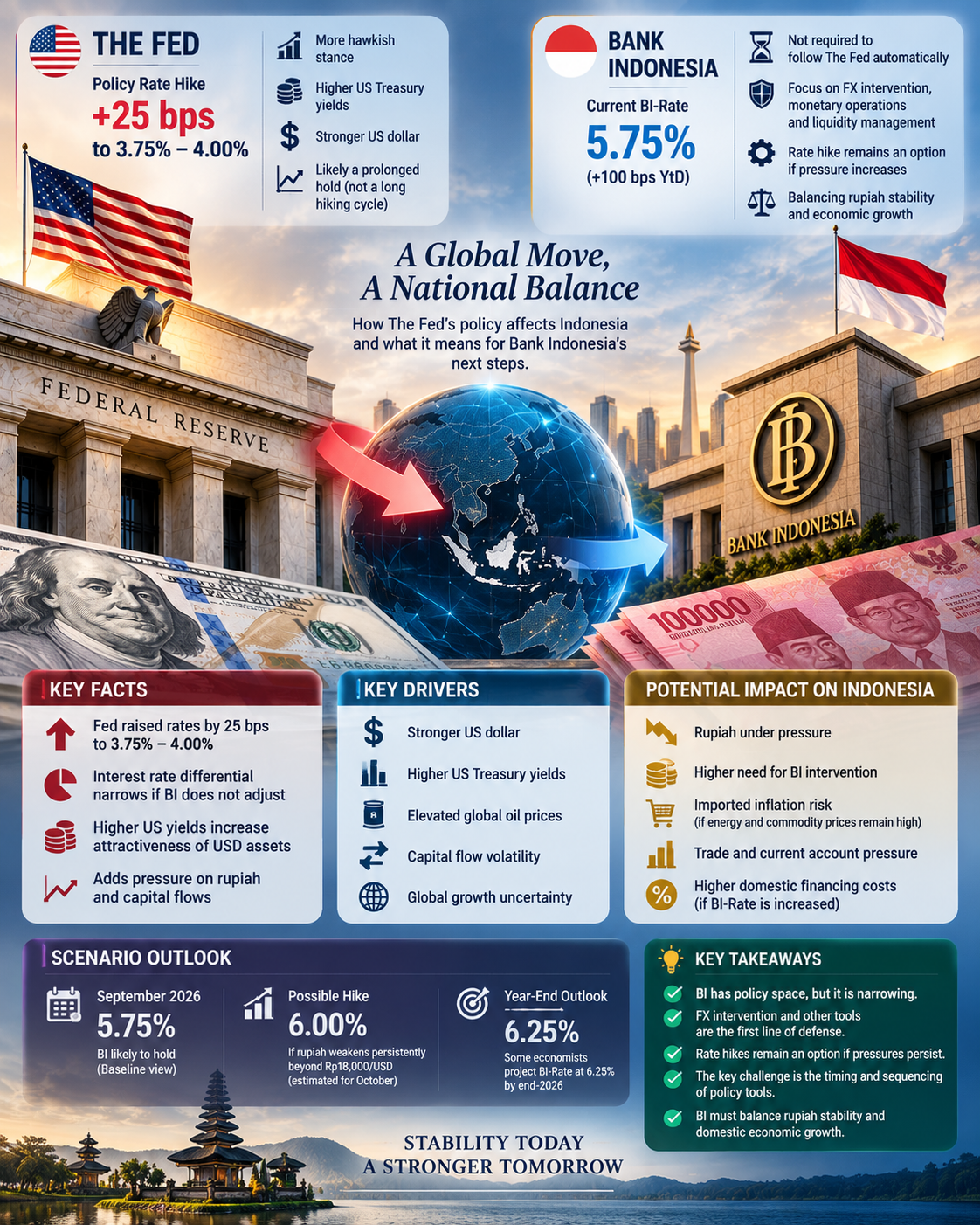
Key Takeaways
Bank Indonesia Policy Sequencing 2026 is fundamentally about timing and instrument choice.
The Fed’s latest hike narrows Indonesia’s policy space, but it does not force BI into an immediate rate response. FX intervention, monetary operations, and liquidity management may absorb the first wave of pressure, while BI-Rate increases remain a stronger option if rupiah weakness and capital outflows become persistent.
The key challenge for BI is therefore not simply whether to tighten, but how to sequence its policy tools without sacrificing either currency stability or domestic economic momentum.
For professional foreign-currency exchange, Cash X Change operates as an Authorized Money Changer, providing competitive and transparent exchange rates. For international remittances, Ditransferin supports cross-border transfers and receiving or withdrawing funds through Western Union.
Source: Kontan and Investor Daily, September 17, 2026