




Global Portfolio Repricing 2026 is becoming a major theme across financial markets after the Federal Reserve raised its policy rate to 3.75%–4.00%, reinforcing expectations that US monetary conditions could remain tighter for longer.
The decision itself was widely anticipated. What matters more is how investors are repositioning after the Fed’s message. A unanimous rate hike, hawkish communication from Fed Chair Kevin Warsh, and inflation that remains above target are forcing markets to reassess bond exposure, equity risk, and currency positions.
Global Portfolio Repricing 2026 Begins with a Hawkish Fed
The latest Global Portfolio Repricing 2026 reflects a change in how investors view the Fed’s inflation commitment.
Investor confidence in the Fed’s willingness to fight inflation has improved, although uncertainty remains over how far rates may need to rise. The 25-basis-point increase was approved unanimously, strengthening expectations that additional tightening could still follow.
That matters because markets entered 2026 expecting rate cuts. Higher energy prices and persistent inflation have since forced a sharp reversal in those expectations.
Why Higher Yields Change Investor Allocation
A key feature of Global Portfolio Repricing 2026 is the reassessment of interest-rate-sensitive assets.
US Treasury yields rose sharply after the Fed decision, with the 10-year yield briefly moving above 5% before easing to around 4.95%. The 30-year yield stood near 5.30%.
Higher yields can make US fixed-income assets more attractive relative to riskier investments. Small-cap stocks and other rate-sensitive assets may also become less attractive as borrowing costs remain elevated.
For global investors, this means portfolio allocation may increasingly favor yield, liquidity, and defensive positioning.
The Rupiah Feels the Repricing Through Capital Flows
The impact is already visible in Indonesia.
The rupiah closed at Rp17,753 per US dollar on September 17, weakening 0.32% in the spot market. JISDOR also recorded the rupiah at Rp17,753, down from Rp17,712 a day earlier.
The move partly reflects market repricing after the Fed hike, as investors adjust their portfolios in response to tighter US monetary conditions.
This illustrates an important transmission channel in Global Portfolio Repricing 2026: when US yields rise, emerging-market currencies can face pressure as capital reallocates toward dollar assets.
Oil and Treasury Yields Add a Second Layer of Pressure
The rupiah’s outlook is not driven by Fed policy alone.
Two other variables remain important: US Treasury yields near 5% and Brent crude around US$104 per barrel. Both can influence capital flows and Indonesia’s external position.
Lower US yields could reduce pressure on emerging-market assets, while softer oil prices may help improve sentiment toward Indonesia.
This means the next phase of Global Portfolio Repricing 2026 may depend on how these market variables move together.
Indonesia Still Has Domestic Buffers
Indonesia is not entering this environment without protection.
Bank Indonesia has already raised rates by a cumulative 100 basis points, while foreign-exchange reserves stand at approximately US$146.5 billion. Fiscal discipline and expectations that BI may keep its policy rate at 5.75% also provide support for market confidence.
These buffers cannot eliminate external volatility, but they can influence how strongly global repricing is transmitted into the rupiah.
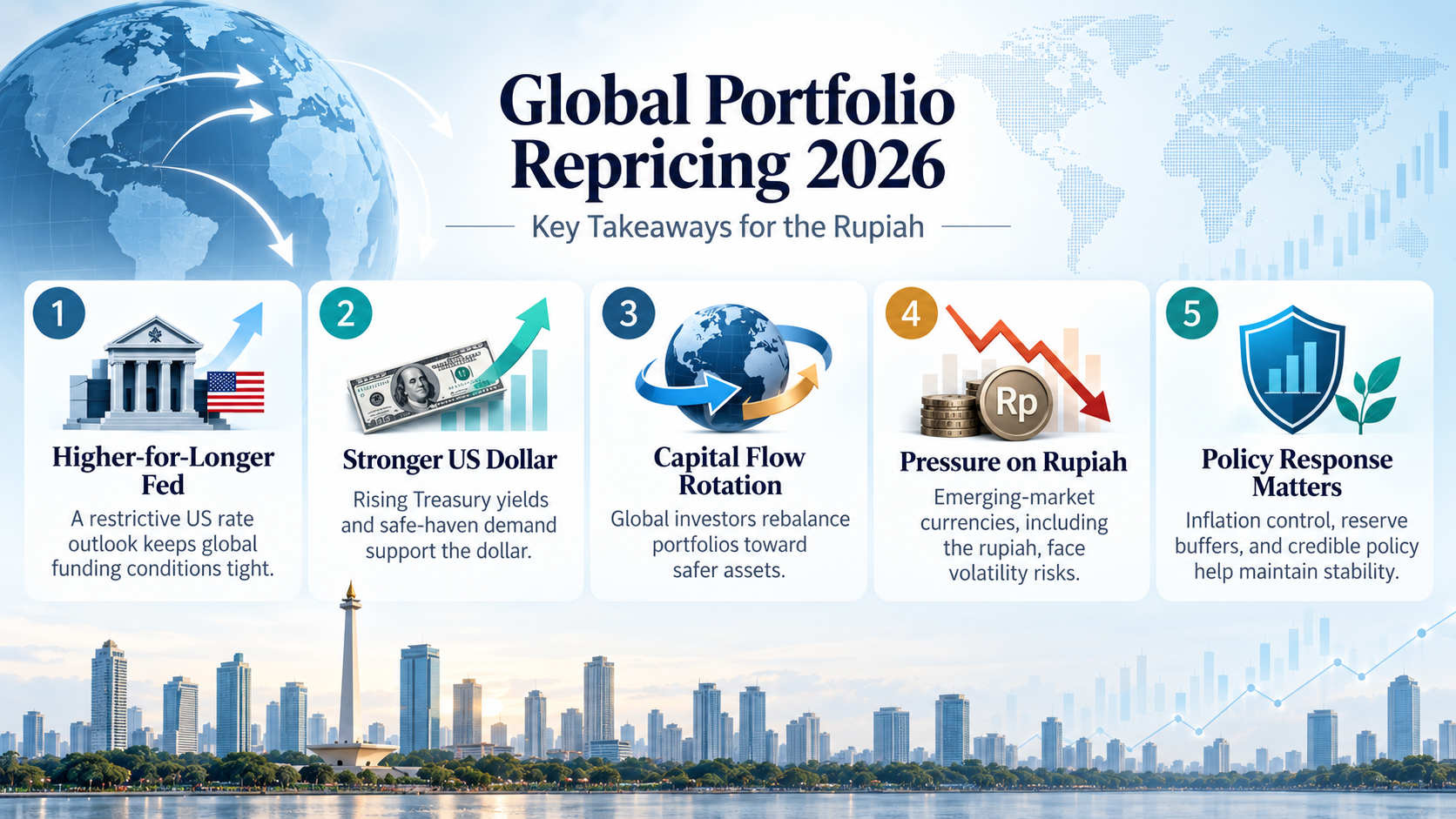
Key Takeaways
Global Portfolio Repricing 2026 is not simply about one Fed rate hike.
It represents a broader reallocation of capital across bonds, equities, and currencies as investors adapt to higher US rates, elevated Treasury yields, persistent inflation, and a more hawkish Fed.
For the rupiah, the key issue is how global capital flows interact with domestic buffers such as BI policy, foreign-exchange reserves, and fiscal credibility.
For professional foreign-currency exchange, Cash X Change operates as an Authorized Money Changer, providing competitive and transparent exchange rates. For international remittances, Ditransferin supports cross-border transfers and receiving or withdrawing funds through Western Union.
Source: Investor Daily and Kontan, September 18, 2026