



Indonesia Digital Payment Connectivity 2026 is moving into a new phase as Bank Indonesia expands cooperation on cross-border digital payments and opens the way for future QRIS connectivity with Timor-Leste.
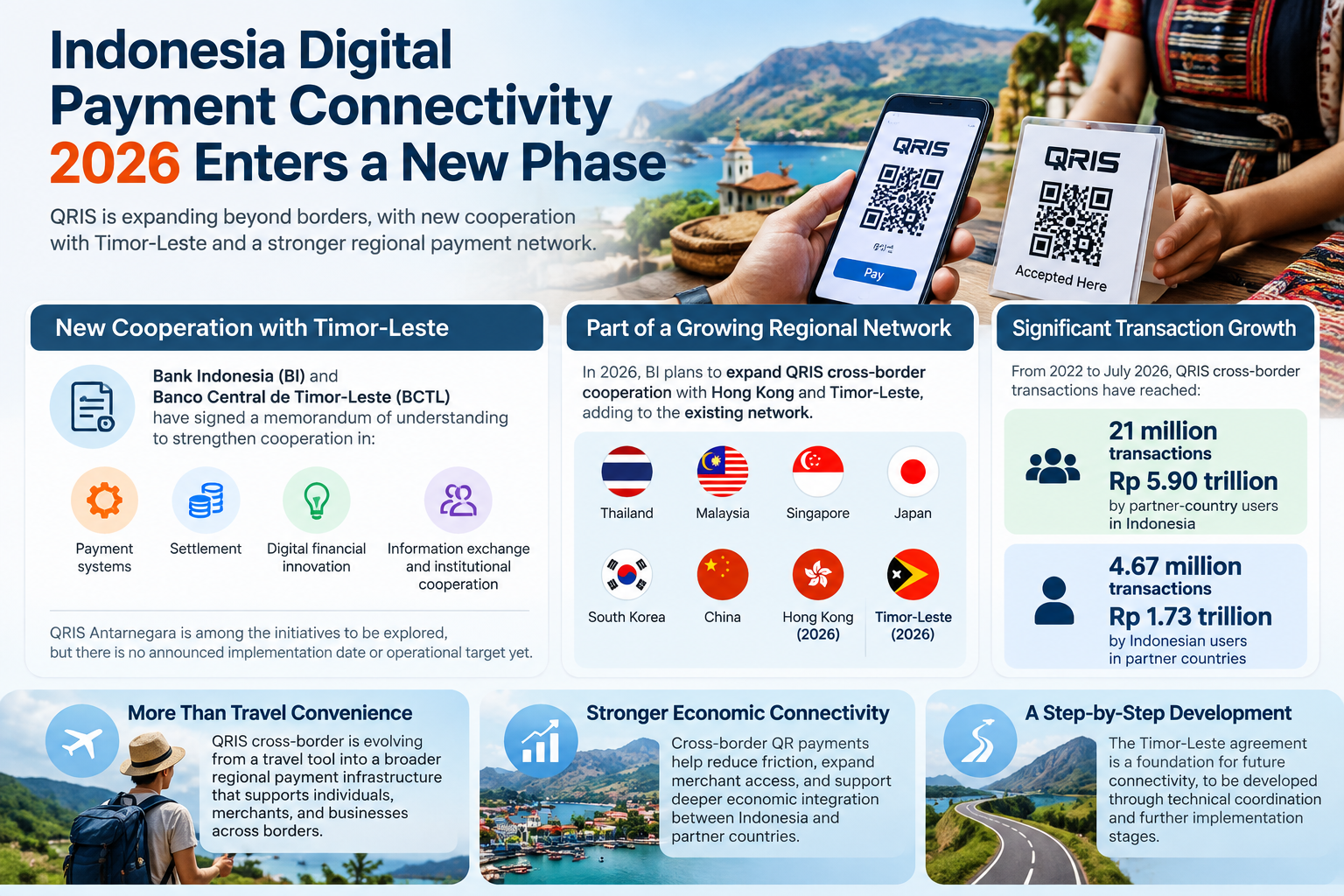
The latest development follows an agreement between Bank Indonesia and Banco Central de Timor-Leste to strengthen cooperation in payment systems, settlement, digital financial innovation, information exchange, and institutional relations.
The agreement does not mean QRIS is already operational in Timor-Leste. Instead, it creates the foundation for future cross-border payment connectivity and places QRIS Antarnegara among the initiatives that both central banks plan to explore.
Indonesia Digital Payment Connectivity 2026 Goes Beyond QR Payments
At first glance, cross-border QRIS may look like a simple travel convenience.
A traveler scans a QR code, completes a payment, and avoids some of the friction associated with cash-based transactions.
But the broader story of Indonesia Digital Payment Connectivity 2026 is increasingly about interoperability between payment systems.
The planned cooperation with Timor-Leste covers more than customer-facing QR payments. It also includes settlement, digital financial innovation, and closer institutional cooperation between the two central banks.
This suggests that cross-border QR connectivity is developing as part of a wider regional payment infrastructure rather than as a standalone consumer feature.
Timor-Leste Adds a New Dimension to Regional Connectivity
Bank Indonesia has identified Timor-Leste and Hong Kong as destinations for further QRIS cross-border expansion in 2026.
The broader network already includes connectivity involving Thailand, Malaysia, Singapore, Japan, South Korea, and China.
Timor-Leste adds a different dimension to that expansion.
Instead of viewing QRIS only through the lens of major tourism or commercial destinations, the cooperation shows how digital payment connectivity can also strengthen economic links with neighboring countries.
For Indonesia Digital Payment Connectivity 2026, this is important because payment interoperability can support individuals, merchants, and businesses across borders while reducing friction in everyday transactions.
Cross-Border QRIS Is Already Handling Significant Transaction Value
The growth of QRIS Antarnegara is no longer only a policy concept.
From its first implementation in 2022 through July 2026, users from partner countries recorded around 21 million QRIS cross-border transactions in Indonesia, with a total value of approximately Rp5.90 trillion.
During the same period, Indonesian users completed around 4.67 million transactions in partner countries, valued at approximately Rp1.73 trillion.
That means transaction value from partner-country users inside Indonesia was around Rp4.17 trillion higher than the value generated by Indonesian users abroad.
These figures do not explain why the difference exists, but they do show that cross-border QR payments are already supporting substantial real-world economic activity.
From Cashless Travel to Regional Payment Infrastructure
The next phase of Indonesia Digital Payment Connectivity 2026 is therefore about more than making travel easier.
Cross-border QR connectivity can reduce payment friction between countries, support wider merchant access, and create a more interconnected payment environment.
The development can be viewed as a progression:
domestic QR standard → cross-border payment tool → regional interoperability → broader economic connectivity.
This is where the significance of the Timor-Leste agreement becomes clearer.
The value is not simply that another country may eventually join the QRIS network. The larger shift is that central banks are creating the institutional and technical foundations needed for payment systems to work more closely across borders.
Implementation Still Requires Further Development
It is important to separate the agreement from actual operational availability.
Bank Indonesia and Banco Central de Timor-Leste have not announced an implementation date or operational target for QRIS Antarnegara between the two countries.
For now, the agreement should be understood as a framework for future cooperation and exploration.
That distinction matters because Indonesia Digital Payment Connectivity 2026 is still being built step by step through bilateral agreements, technical coordination, and payment-system development.
Key Takeaways
Indonesia Digital Payment Connectivity 2026 is evolving from a domestic digital-payment success story into a broader regional connectivity strategy.
The planned cooperation with Timor-Leste shows that QRIS cross-border development is moving beyond tourism convenience toward deeper payment-system interoperability.
With 21 million partner-country transactions in Indonesia worth Rp5.90 trillion through July 2026, cross-border QRIS already has meaningful transaction activity.
The next challenge is converting bilateral cooperation into reliable, secure, and operational payment connectivity while maintaining efficiency and accessibility for users and merchants.
The expansion of cross-border QR connectivity shows how payment systems are becoming increasingly integrated across the region. Even so, travelers and businesses may still rely on a mix of digital payments, cash, and international transfer services depending on their needs.
Cash X Change operates as an Authorized Money Changer, providing transparent foreign currency exchange services and exchange rates. Ditransferin supports international money transfers and receiving funds through Western Union.
Source: Investor Daily, September 25, 2026; Kontan, September 23, 2026