
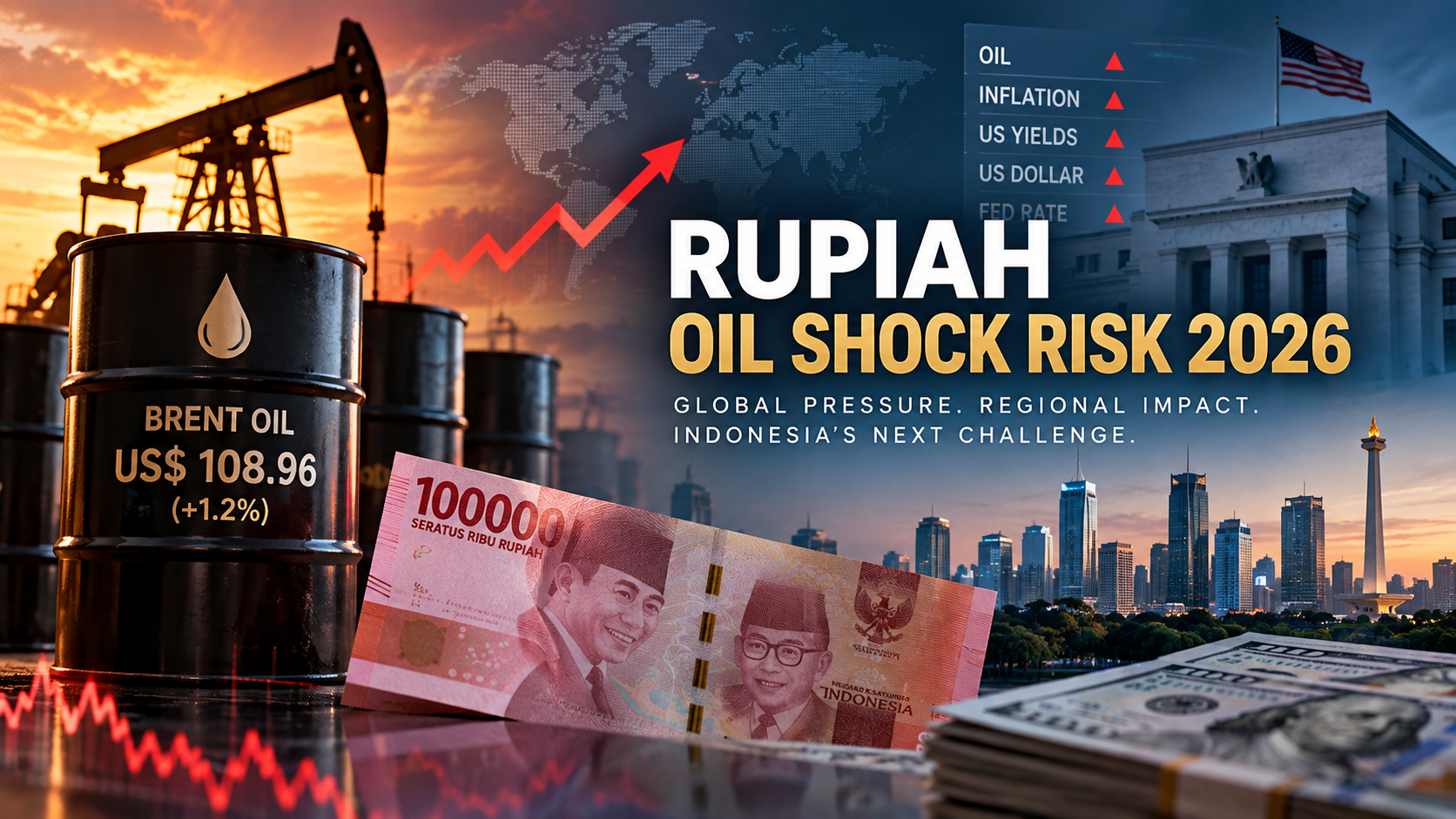



Rupiah Oil Shock Risk 2026 is becoming more relevant as rising energy prices begin to influence inflation expectations, global bond yields, and the outlook for US monetary policy at the same time.
On September 11, 2026, the rupiah opened 0.22% weaker at around Rp17,585 per US dollar, while the US Dollar Index held near 99.072. The move came as investors turned more cautious over energy-supply risks in the Middle East, with Brent crude rising 1.2% to US$108.96 per barrel.
Rupiah Oil Shock Risk 2026 Starts with Higher Energy Prices
The core issue behind Rupiah Oil Shock Risk 2026 is that oil can influence currency markets through more than one channel.
Higher energy prices can lift inflation expectations, especially when supply disruptions are linked to geopolitical tensions. That can make central banks less willing to ease policy and may even revive expectations of further tightening.
Investor Daily reported that the probability of a Federal Reserve rate increase had risen to around 70%, while US bond yields remained elevated and the dollar benefited from safe-haven demand.
Oil Is Feeding Global Inflation Expectations
Kontan also highlighted that Brent crude had moved above US$100 per barrel, increasing concern that prolonged supply disruptions could push global inflation higher.
That matters because inflation risk can restrict the room available for central banks to lower interest rates. In some cases, it may even lead markets to price in tighter monetary policy instead.
For Rupiah Oil Shock Risk 2026, this means the pressure does not come only from the oil price itself. It also comes from how energy costs reshape expectations for inflation, interest rates, and global liquidity.
Higher Fed Expectations Strengthen the Dollar
A stronger dollar is another important transmission channel.
As markets increased expectations of a Fed rate hike, the US currency gained support from both higher yields and risk-aversion. Investor Daily noted that producer prices in the United States rose 0.4% in August, reinforcing concern over inflation and supporting the dollar’s recent strength.
This combination can make conditions more difficult for emerging-market currencies because higher US yields increase the relative attractiveness of dollar assets.
Asian Currencies Feel the Pressure Unevenly
The rupiah is not alone.
On the same trading day, the Malaysian ringgit, Taiwan dollar, Philippine peso, and Thai baht also weakened against the US dollar. However, the Korean won and Japanese yen posted modest gains.
This shows that global shocks do not affect every Asian currency in the same way.
Regional currencies are exposed to the same broad forces—oil prices, US yields, and Fed expectations—but domestic conditions and market positioning can still produce different outcomes.
Year-to-Date Weakness Shows a Smaller Buffer
The broader 2026 trend remains important for Rupiah Oil Shock Risk 2026.
Since the end of 2025, the rupiah has weakened around 5.18%, moving from Rp16,670 to roughly Rp17,580 per US dollar. The Philippine peso has fallen 6.23%, the Indian rupee 5.84%, and the Thai baht 5.09%.
By contrast, the Korean won has strengthened 6.89%, the Chinese yuan 4.12%, the Japanese yen 1.48%, and the Singapore dollar 1.38%.
That divergence suggests the rupiah enters the latest oil-driven volatility with less room than several stronger-performing regional currencies.
Why Oil Can Become a Double Risk for Indonesia
The key insight is that an oil shock can create a chain reaction.
Higher energy prices may increase inflation pressure globally, strengthen expectations for tighter US monetary policy, support the dollar, and place renewed pressure on Asian currencies.
For Indonesia, that makes Rupiah Oil Shock Risk 2026 more than a simple commodity story. It is also a monetary and financial-market story.
Key Takeaways
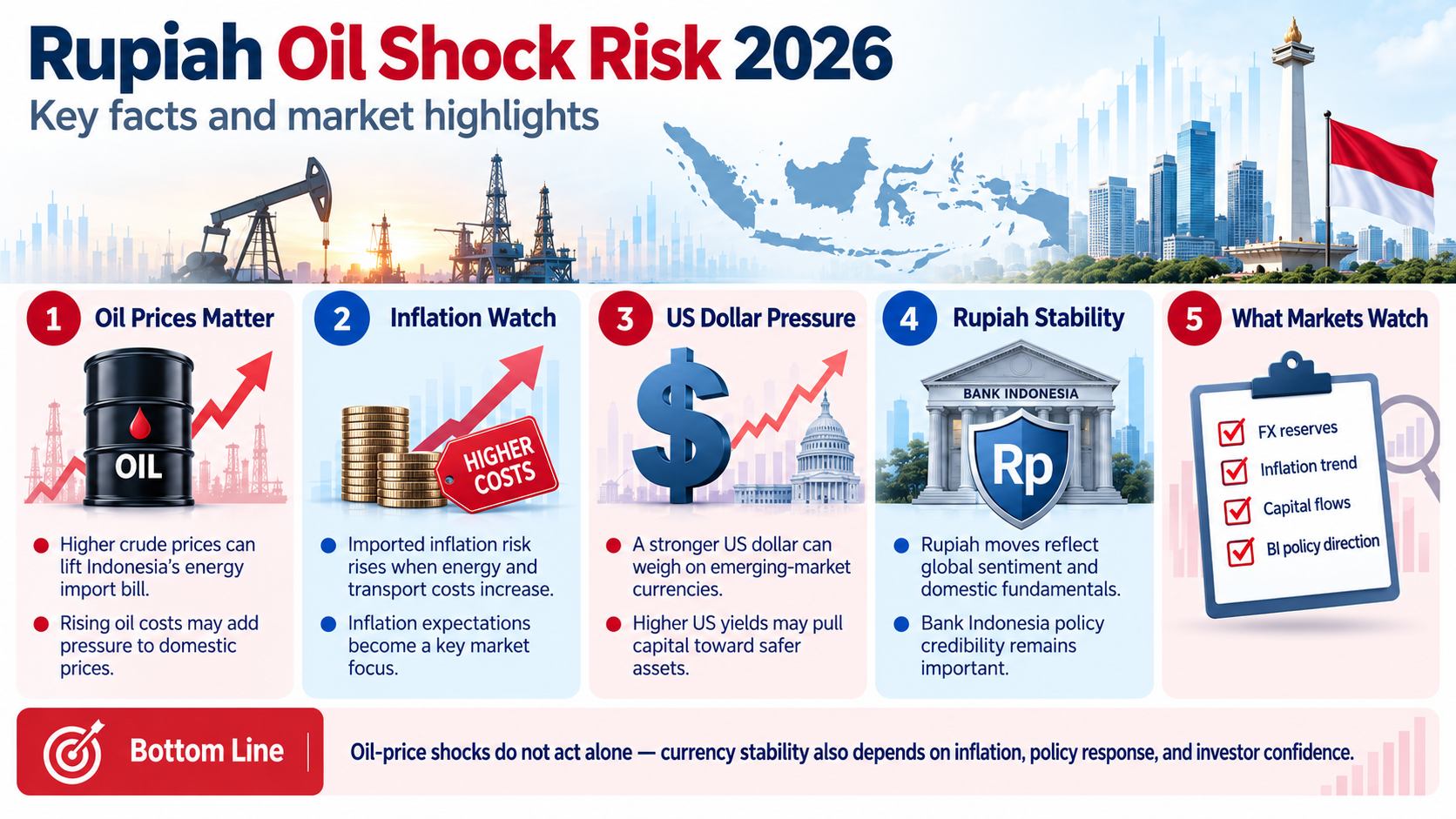
Rupiah Oil Shock Risk 2026 highlights how geopolitical tension can transmit into currency markets through energy prices, inflation expectations, bond yields, and interest-rate expectations.
The rupiah’s latest weakness reflects this broader repricing rather than a purely domestic move.
The main risk is therefore not only higher oil prices themselves, but the possibility that they keep global inflation elevated, delay monetary easing, strengthen the dollar, and prolong pressure on emerging-market currencies.
For professional foreign-currency exchange, Cash X Change operates as an Authorized Money Changer, providing competitive and transparent exchange rates. For international remittances, Ditransferin supports cross-border transfers and receiving or withdrawing funds through Western Union, helping customers manage international financial needs securely and conveniently.
Source: Investor Daily and Kontan, September 11, 2026