




Rupiah Shock Absorption 2026 is becoming a critical test for Bank Indonesia as the currency faces simultaneous pressure from higher US Treasury yields, elevated oil prices, portfolio outflows, and rising domestic demand for foreign exchange.
On September 24, 2026, the rupiah weakened toward Rp17,894 per US dollar in the spot market. Analysts emphasized that the move was not primarily caused by Bank Indonesia’s decision to keep the BI-Rate unchanged. Instead, the pressure was largely external, while domestic importer demand added another layer of stress.
The key question is therefore not whether BI can eliminate volatility, but whether Indonesia’s financial system can absorb overlapping pressures without allowing short-term market movements to develop into broader instability.
Rupiah Shock Absorption 2026 Faces Multiple Pressures
The central challenge behind Rupiah Shock Absorption 2026 is that several risk factors are appearing at the same time.
The US Dollar Index remains firm, US bond yields have risen, oil prices are still elevated, and geopolitical uncertainty continues to influence financial markets.
At the same time, capital has been moving out of emerging-market assets, increasing competition for global liquidity.
This combination makes the rupiah more sensitive to changes in global risk appetite.
US Treasury Yields Become a Major Transmission Channel
One of the strongest sources of external pressure is the US Treasury market.
The 10-year Treasury yield climbed to around 5.11%, its highest level since 2007. Higher US yields increase the relative attractiveness of dollar-denominated assets and can encourage investors to reduce exposure to emerging markets.
For Rupiah Shock Absorption 2026, this matters because pressure can reach Indonesia not only through the dollar itself, but also through the global reallocation of capital toward higher-yielding US assets.
Oil and Geopolitics Add a Second Layer of Risk
Energy markets are creating another source of uncertainty.
Brent crude moved back above US$100 per barrel as tensions in the Middle East revived concerns over global oil supplies.
Higher oil prices can influence inflation expectations, external balances, and demand for foreign currency.
That means rupiah pressure can intensify even when the domestic monetary-policy stance itself has not changed.
Quarter-End Importer Demand Adds Domestic FX Pressure
The latest Rupiah Shock Absorption 2026 episode also includes a domestic component.
Foreign-exchange demand from Indonesian importers increased ahead of the end of the third quarter. When stronger domestic dollar demand coincides with global capital outflows, the FX market can experience tighter short-term liquidity.
This creates a timing challenge for Bank Indonesia: the central bank must manage market demand while preventing temporary imbalances from becoming disorderly currency moves.
BI Is Intervening Across More Than One Market
Bank Indonesia’s response goes beyond traditional spot intervention.
BI has reiterated its commitment to use spot transactions, Domestic Non-Deliverable Forwards, and offshore Non-Deliverable Forwards.
It is also using secondary-market government bond purchases and pro-market monetary operations to manage liquidity and the structure of money-market interest rates.
This makes Rupiah Shock Absorption 2026 a cross-market stabilization exercise rather than a single-market currency defense.
Why Rp18,000 Is a Psychological Test
Analysts expect the rupiah to remain volatile in the short term, with a range of approximately Rp17,750–Rp18,000 per US dollar.
The Rp18,000 level is important primarily as a psychological resistance point.
If global pressure from the dollar, US yields, and oil intensifies, that level could be tested. If external conditions ease and BI intervention proves effective, the rupiah could move back below Rp17,800.
Importantly, the broader picture remains more balanced: the rupiah was still around 0.46% stronger quarter-to-date.
FX Reserves Strengthen Intervention Credibility
Indonesia’s foreign-exchange reserves stood at approximately US$146.5 billion at the end of August 2026.
For Rupiah Shock Absorption 2026, this reserve position matters because market confidence depends not only on BI’s willingness to intervene, but also on its capacity to sustain stabilization measures when volatility rises.
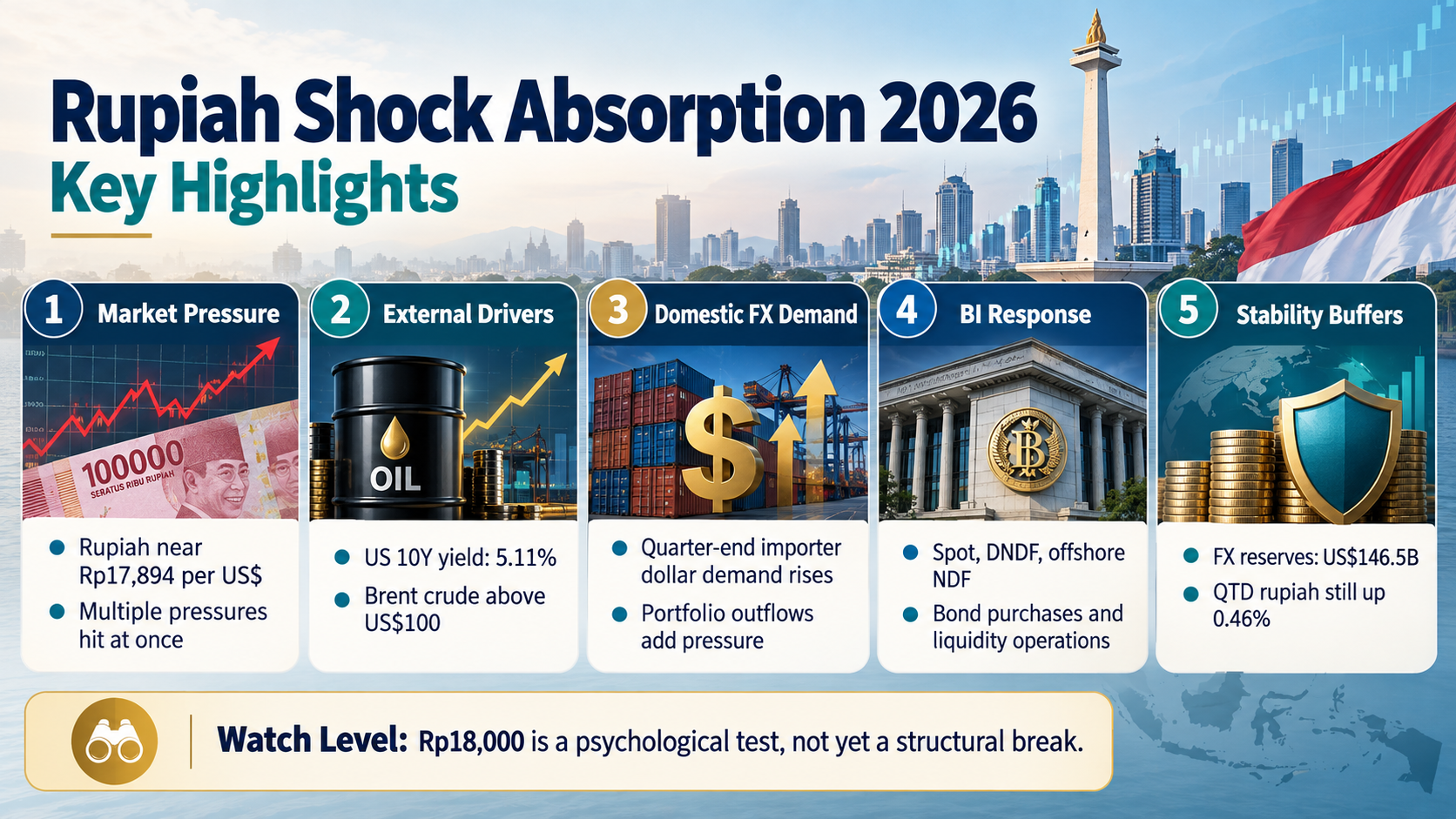
Key Takeaways
Rupiah Shock Absorption 2026 is ultimately a test of how effectively Indonesia can manage simultaneous global and domestic pressures.
Higher US yields, oil prices, portfolio outflows, and importer FX demand are all influencing the rupiah at the same time.
BI’s strategy therefore relies on multiple channels—spot intervention, DNDF, offshore NDF, bond-market operations, and liquidity management—to prevent volatility from becoming instability.
For professional foreign-currency exchange, Cash X Change operates as an Authorized Money Changer, providing competitive and transparent exchange rates. For international remittances, Ditransferin supports cross-border transfers and receiving or withdrawing funds through Western Union.
Source: Kontan and Investor Daily, September 24, 2026