




Rupiah Strong Dollar Cycle 2026 is becoming increasingly visible as the Indonesian rupiah faces renewed pressure from a stronger US dollar, rising global yields, and persistent uncertainty in energy markets.
On October 1, 2026, the rupiah opened slightly weaker at around Rp17,906–Rp17,908 per US dollar, down about 0.07–0.08% from the previous closing level of Rp17,894. The move was relatively small, but the broader market context suggests that the rupiah is operating within a much larger global dollar cycle.
The key question is therefore not only why the rupiah weakened, but why the US dollar continues to attract global demand.
Rupiah Strong Dollar Cycle 2026 Is Driven by Global Dollar Strength
Investor Daily reported that the US dollar remained near a two-month high, supported by rising US government bond yields and concerns over continued global energy price pressure.
The dollar had also gained around 2% throughout September 2026, reflecting stronger demand for dollar-denominated assets.
This creates a challenging environment for emerging-market currencies.
Higher US Treasury yields make dollar assets more attractive. As investor preference shifts toward US assets, capital can move away from emerging markets, increasing pressure on local currencies.
Rupiah Strong Dollar Cycle 2026 therefore reflects how changes in US yields can quickly transmit into emerging-market currency movements.

Energy Prices Connect Geopolitical Risk With Currency Pressure
One of the most important links in the current market environment is global energy uncertainty.
Investor Daily noted that higher US bond yields were partly driven by concerns over continued energy price pressures linked to conflict in the Middle East.
The transmission mechanism is straightforward:

This energy-to-yield transmission is another important driver of Rupiah Strong Dollar Cycle 2026.
When inflation concerns remain elevated, investors may expect tighter monetary conditions for longer. That supports bond yields and can strengthen demand for the US dollar.
Rupiah Pressure Is Part of a Wider Asian Currency Trend
Kontan reported that the rupiah weakened alongside most Asian currencies.
The Japanese yen fell 0.47%, the South Korean won and Thai baht each weakened 0.26%, the Singapore dollar declined 0.16%, the Philippine peso lost 0.13%, and the Malaysian ringgit weakened 0.1%.
This regional pattern is important.
When several Asian currencies weaken at the same time, external forces are often more significant than country-specific developments.
Regional weakness therefore reinforces the view that Rupiah Strong Dollar Cycle 2026 is part of a broader Asian response to dollar strength rather than an isolated Indonesian event.
Short-Term Weakness Does Not Tell the Whole Story
Despite renewed pressure, the rupiah had previously strengthened by 87 points or 0.48% to Rp17,894 on September 30 before weakening slightly at the following opening session.
This shows that short-term exchange-rate movements remain highly sensitive to changing market sentiment.
Rupiah Strong Dollar Cycle 2026 should therefore be interpreted through both daily price movements and the wider global financial environment.
For businesses, travelers, and market participants, this matters because exchange rates are influenced by more than domestic economic conditions alone.
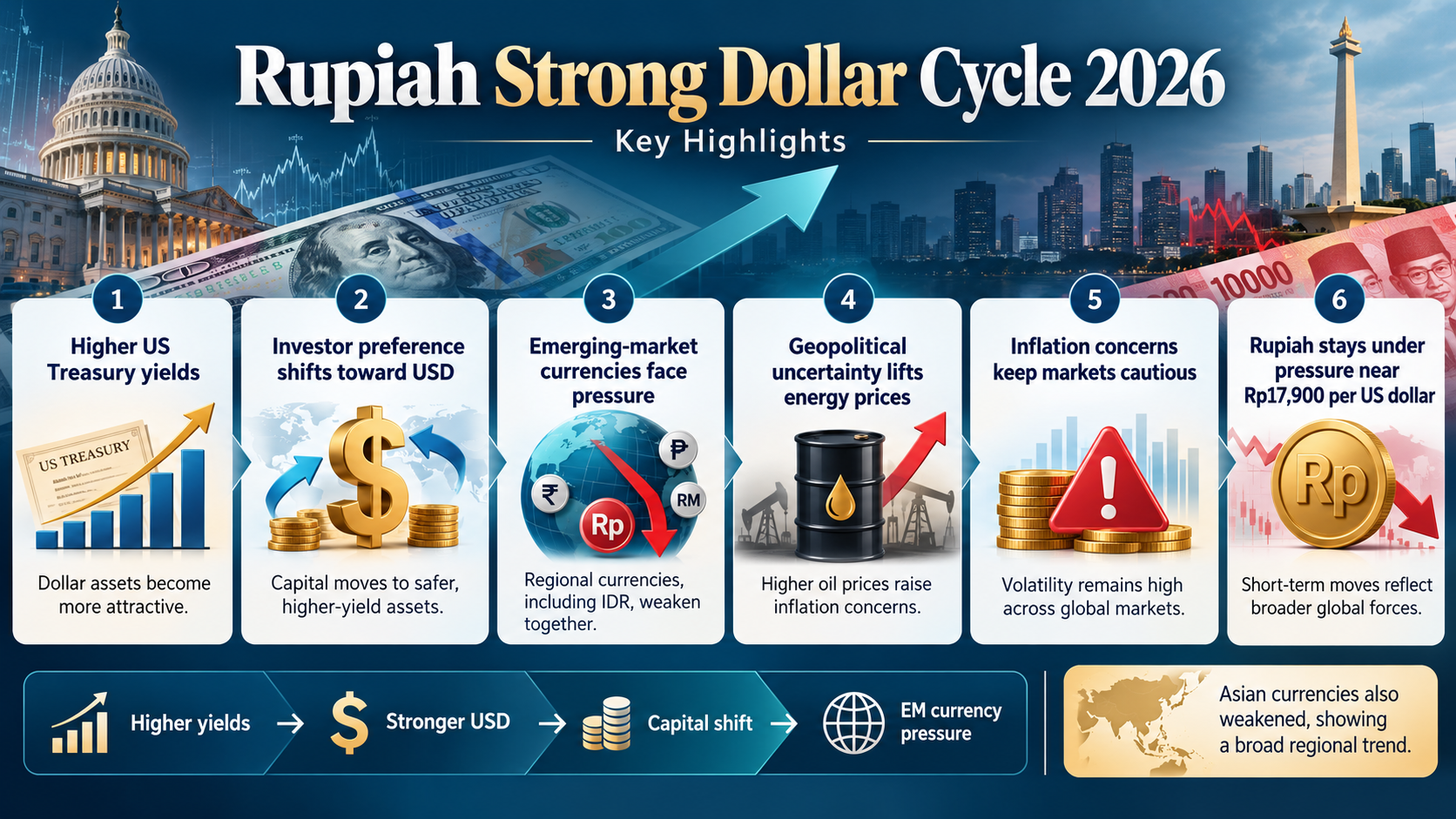
Key Takeaways
Rupiah Strong Dollar Cycle 2026 reflects the interaction between global yields, energy uncertainty, investor preferences, and regional currency movements.
The rupiah’s movement near Rp17,900 per US dollar is not simply a domestic story. It forms part of a broader global adjustment where stronger demand for dollar assets continues to pressure emerging-market currencies.
The fact that several Asian currencies weakened simultaneously supports the view that global forces remain dominant.
A stronger dollar environment does not automatically mean fundamental weakness in every emerging-market economy. Instead, it highlights how closely interconnected modern financial markets have become.
For businesses and travelers, understanding Rupiah Strong Dollar Cycle 2026 provides useful context for interpreting exchange-rate movements beyond the headline USD/IDR level.
Cash X Change operates as an Authorized Money Changer, providing competitive and transparent foreign-exchange services and exchange rates. Ditransferin supports international money transfers and receiving funds through Western Union.
Source: Investor Daily and Kontan, October 1, 2026